In a world where precision meets portability, you’ve probably struggled countless times to drill perfectly straight holes with your handheld drill. Whether you’re working on furniture, crafts, or home repairs, achieving professional-level accuracy can feel impossible without the right equipment. Your search for the perfect portable drill guide doesn’t have to end in frustration – these four top-rated options will transform your drilling game and deliver the results you’ve been chasing.
Portable Drill Guide for Straight Holes (WT116A)
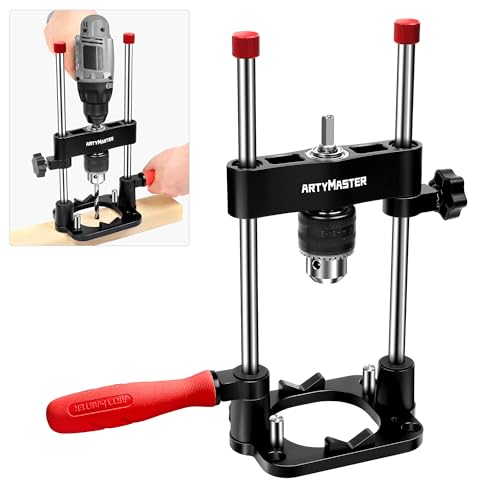

For DIYers and woodworking enthusiasts who need drill press precision without the bulk, the ArtyMaster Portable Drill Guide WT116A transforms your handheld drill into a stable drilling station.
This all-metal guide fits 3/8 and 1/2 drills and accepts bits from 1.5-13mm. You’ll get accurate vertical holes thanks to chrome-plated steel rails and a depth stop control. The built-in centering pin and V-groove help you align perfectly on round materials.
While you’ll appreciate its solid construction and smooth operation, you’ll need to manage the chuck key separately as there’s no storage for it. At 3.97 pounds, it’s portable yet sturdy enough for professional-grade results.
Best For: DIY enthusiasts and woodworkers seeking drill press accuracy in a portable format for creating precise vertical holes in tight spaces.
Pros:
- High-precision vertical drilling with chrome-plated steel rails and depth stop control
- Versatile compatibility with both 3/8″ and 1/2″ drills and wide range of bit sizes (1.5-13mm)
- Durable all-metal construction with stable base and V-groove for round materials
Cons:
- No built-in storage for required chuck key
- Heavy weight (3.97 lbs) can make extended use tiring
- May require additional hand support for optimal stability during use
Rockler Portable Drill Guide for Hand Drill
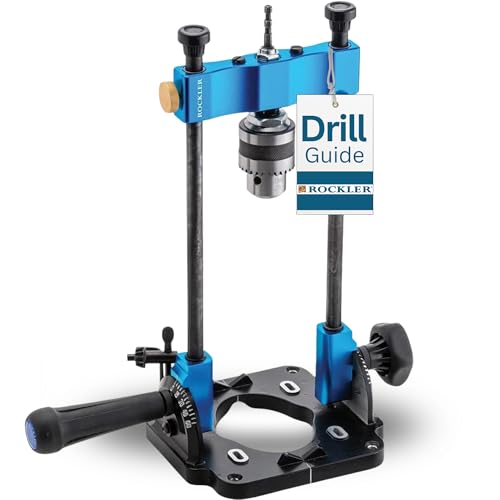
Space-conscious woodworkers will appreciate the Rockler Portable Drill Guide, a compact alternative to traditional drill presses. At just 0.04 pounds, this aluminum-built tool transforms your hand drill into a precise drilling station.
You’ll find helpful features like adjustable angles from 0° to 60°, a depth stop for consistent holes, and self-centering pins for accurate dowel work. The 1/4″ hex shank attachment and 1/2″ chuck accommodate various bit sizes, while rubber-cased handles and smooth ball bearings guarantee comfortable operation.
With a 4.4 rating from users, it’s praised for its precision and portability, though some note concerns about chuck durability.
Best For: Hobbyist woodworkers and DIY enthusiasts working in small spaces who need precise drilling capabilities without investing in a full-size drill press.
Pros:
- Portable and lightweight design ideal for small workshops
- Versatile angle adjustments from 0° to 60° with depth stop feature
- Self-centering pins ensure accurate hole placement in dowels
Cons:
- Chuck durability issues reported by some users
- Less robust than a traditional drill press
- Customer service response times could be slow
Portable Drill Guide with Adjustable Angle for Straight Holes

Professional craftsmen and DIY enthusiasts seeking precision drilling without a full-size drill press will find their solution in this portable drill guide. You’ll appreciate its versatile 0° to 60° angle adjustment and precision-machined 6061 aluminum alloy construction.
The guide’s dual lock system and depth stop collar guarantee accurate, repeatable results, while its crosshair alignment grid helps you achieve millimeter-precise placement. You can drill centered holes in materials up to 4.9 inches wide using the removable centering pins, and the V-groove support securely holds round stock up to 3 inches. It’s compatible with both 3/8 and 1/2 power drills, making it a practical choice for wood, metal, and composite materials.
Best For: Woodworkers, metalworkers, and DIY enthusiasts who need precise angled or straight holes but don’t have space or budget for a full-size drill press.
Pros:
- Versatile angle adjustment from 0° to 60° with precision calibration
- Robust aluminum construction with dual locking system for stability
- Compatible with multiple drill sizes and materials, including built-in V-groove for round stock
Cons:
- Stock springs may need upgrading for better performance
- Vinyl caps can lose grip over time
- At 5.21 pounds, it’s relatively heavy for portable use
Milescraft DrillMate Portable Drilling Guide (1318)

The Milescraft DrillMate Portable Drilling Guide (1318) transforms your handheld drill into a precision drilling station, making it ideal for DIY enthusiasts and hobbyists who can’t justify a full-size drill press.
You’ll appreciate its versatility with multiple angle settings (45°, 60°, 75°, and 90°) and compatibility with both 3/8″ and 1/2″ drills. The base features centering channels that accommodate round stock up to 3 inches in diameter. While it’s lightweight and portable, some users note it can be top-heavy during operation. For best results, you might want to secure it to a base when working on precision tasks. With a 4.3-star rating from nearly 10,000 reviews, it’s a reliable tool for most drilling projects.
Best For: DIY enthusiasts and home woodworkers who need precision drilling capabilities without investing in a full-size drill press.
Pros:
- Versatile angle settings (45°, 60°, 75°, 90°) for various drilling needs
- Compatible with both 3/8″ and 1/2″ drills with included chuck
- Built-in centering channels for round stock up to 3 inches in diameter
Cons:
- Top-heavy design can affect stability during operation
- Less precise than a dedicated drill press for high-precision tasks
- May require additional stabilization or mounting for best results
Factors to Consider When Choosing a Drill Press for Portable Drill
When you’re shopping for a drill press attachment for your portable drill, you’ll need to check vital specifications like size limits, weight capacity, and chuck compatibility to guarantee a proper fit with your existing tool. You should evaluate the quality of materials used in construction and verify that the depth control features match your project needs. The ability to make precise angle adjustments can greatly expand your drilling capabilities, so look for models offering versatile angle settings.
Size and Weight Limits
Size and weight factors play an essential role in selecting the right drill press for your portable drill. You’ll need to match the guide’s dimensions, typically ranging from 12 to 18 inches in height, to your workspace constraints and storage requirements.
When choosing your drill press, you’ll want to evaluate its weight, which usually falls between 4 to 6 pounds. Pay close attention to how the weight is distributed throughout the unit, as top-heavy models can compromise stability and accuracy during operation. If you’re frequently moving between job sites, opt for a more compact and lightweight design that won’t sacrifice performance. For heavy-duty projects, you might benefit from a larger, more substantial model that provides enhanced stability and can handle more demanding applications.
Chuck Compatibility Range
Beyond physical dimensions, chuck compatibility stands as a key consideration for your drill press selection. You’ll want to verify your drill guide can accommodate various chuck sizes, typically ranging from 3/8 inch to 1 inch, to maximize versatility in your projects.
For precise work, look for guides that support smaller bit diameters starting at 1.5 mm and extending up to 13 mm. If you’re planning to tackle both light and heavy-duty tasks, choose a guide that’s compatible with both 3/8 and 1/2 inch chucks. This flexibility will let you switch between different drilling applications seamlessly.
Before making your final choice, verify that the guide matches your drill’s specific chuck type. This compatibility check will help maintain accuracy and peak performance throughout your drilling operations.
Angle Adjustment Options
A versatile drill press should offer extensive angle adjustment capabilities, typically ranging from 0° to 60°, to help you tackle diverse drilling tasks. When selecting your drill press, look for models equipped with a calibrated protractor scale, which guarantees you’ll achieve precise angle settings every time.
You’ll want to prioritize units featuring a dual lock system with quick-release locking pins. This combination provides stability during operation while making angle changes quick and efficient. If you’re considering portable options, seek out models with self-centering pins, as they’ll help you position holes accurately at various angles. The adjustment mechanism should operate smoothly and intuitively, allowing you to shift between angles without sacrificing precision in your work.
Depth Control Features
Precision depth control stands as a critical feature when selecting a drill press for your portable drill. You’ll want to look for models equipped with integrated depth stop collars that let you quickly set and maintain consistent drilling depths. This feature is especially valuable when you’re working on projects requiring multiple identical holes, like shelf pin installation or dowel joinery.
Make sure to choose a drill press that offers easily adjustable depth stops, as they’ll help you prevent over-drilling and protect your workpiece. Look for models with permanently etched alignment grids, which will give you additional guidance for precise depth settings. These markings can greatly improve your accuracy and efficiency, particularly when you’re switching between different drilling depths throughout your project.
Material Construction Quality
While accurate depth control guarantees precise holes, the material construction of your drill press will determine its long-term performance and reliability. You’ll want to look for models made from chrome-plated steel or aluminum alloy, as these materials offer superior durability while maintaining essential portability.
High-quality materials don’t just affect longevity – they’re vital for stability during operation. A precision-machined design with strong anchoring points will prevent wobbling, ensuring your holes are clean and accurate. When examining construction quality, pay attention to the surface treatment. Hardened surfaces resist scratches and corrosion, which is especially important if you’re planning frequent use. Metal constructions typically outperform plastic alternatives, providing better vibration resistance and more consistent results over time.
Base Stability Design
Solid base stability stands as the cornerstone of any reliable drill press attachment for your portable drill. You’ll want to look for a wider base footprint that prevents tipping, especially when you’re working with heavier drills. Make sure your drill press features counter-sunk mounting holes that let you securely fasten it to your work surface.
Check for dual tension springs in the guide mechanism, as they’ll help maintain consistent alignment while making bit changes easier. The base should be constructed from solid metal to prevent flexing during operation. When examining the design, pay attention to the handle configuration – an ergonomic grip will give you better control, particularly when you’re drilling at angles or in confined spaces.
Centering Pin Mechanisms
When choosing a drill press for your portable drill, a reliable centering pin mechanism serves as your key to achieving precise hole placement. You’ll want to look for adjustable or removable pins that can accommodate various material sizes up to several inches in diameter. This feature is especially important when you’re working with round stock drilling tasks.
Consider models with dual centering pins if you’ll be doing angled drilling, as they provide enhanced stability and prevent bit wandering during operation. The self-centering capability will save you significant setup time, particularly valuable for repetitive tasks where uniformity is essential. For woodworking and metal fabrication projects, you’ll appreciate how these integrated pins simplify the alignment process, letting you focus on achieving clean, accurately positioned holes every time.