In a world where precision makes the difference between a masterpiece and a mess, choosing the right miter saw blade can feel like maneuvering through a maze of options. You’ll find countless 12-inch blades on the market, each promising to be your perfect cutting companion. Whether you’re tackling hardwoods, softwoods, or composite materials, you’re about to uncover six exceptional blades that’ll transform your miter saw into a precision-cutting powerhouse.
Luckyway 12 Inch Miter Saw Blades, 32T & 80T (2-Pack)


For woodworkers seeking versatility, Luckyway’s 2-pack miter saw blade combo offers exceptional value with its 32-tooth general purpose and 80-tooth fine finish blades. These 12-inch blades feature a 1-inch arbor and fully hardened steel construction for accuracy and deflection control.
You’ll appreciate the ATB tooth design that delivers smooth cuts with minimal splintering across various materials, from hardwoods to laminates. The tungsten carbide teeth guarantee durability and efficient chip removal. Users consistently report clean, tear-out-free results and praise the blades’ performance, noting they “cut like butter.” At a competitive price point compared to home improvement store options, you’re getting professional-grade cutting power without breaking the bank.
Best For: Woodworkers and DIY enthusiasts who need versatile blade options for both rough cuts and fine finishing work across various wood materials.
Pros:
- Excellent value with two specialized blades (32T and 80T) in one package
- Hardened steel construction with carbide teeth ensures durability and clean cuts
- Versatile compatibility with multiple materials from hardwoods to laminates
Cons:
- Some users report snug fit during initial mounting
- Limited brand recognition compared to major manufacturers
- May require more frequent sharpening than premium-branded alternatives
WEN 12-Inch Ultra-Fine Finish Professional Saw Blade (BL1200)

Budget-conscious woodworkers will appreciate the WEN BL1200’s impressive balance of performance and affordability. At around $27, this 100-tooth carbide-tipped blade delivers ultra-fine finishes on both hardwoods and softwoods without breaking the bank.
You’ll find this blade compatible with most 12-inch miter saws, jobsite saws, and table saws, spinning at up to 6000 RPM. Its 1/10-inch kerf guarantees clean, efficient cuts with minimal tearout across materials like pine, oak, maple, and even MDF. Users consistently report excellent results and long-lasting performance, making this blade a smart choice for those seeking professional-grade cuts without premium pricing.
Best For: Budget-conscious woodworkers and DIY enthusiasts seeking professional-grade cuts and clean finishes without investing in premium-priced blades.
Pros:
- Excellent value for money with professional-level cutting performance
- Versatile compatibility with most 12-inch saws and various wood types
- Clean, precise cuts with minimal tearout and splintering
Cons:
- Limited warranty period compared to premium blade brands
- May require more frequent replacement than higher-end alternatives
- Some users might need to make slower cuts to achieve optimal results
2-Pack 12in Miter Saw Blade Set (80T & 32T)

Woodworkers seeking versatility will find exceptional value in this two-blade combo pack, featuring both an 80-tooth and 32-tooth configuration. The tungsten carbide blades come equipped with a 1-inch spindle and include a conversion ring for 0.6-inch compatibility.
You’ll appreciate the four expansion grooves that improve heat dissipation during cuts. These blades excel at handling hardwood, plywood, MDF, and particle board. While they’re not multipurpose blades, they deliver reliable performance for their intended materials. If you need support, you can count on 24-hour customer service with responses within 12 hours.
Best For: Woodworking enthusiasts and professionals who primarily work with hardwood, plywood, and particle board and need both fine finish and general-purpose cutting capabilities.
Pros:
- Versatile two-blade set with both fine-finish (80T) and general-purpose (32T) options
- Four expansion grooves provide effective heat dissipation during operation
- Includes conversion ring for compatibility with both 1-inch and 0.6-inch arbors
Cons:
- Not suitable for multipurpose cutting applications
- Mixed reviews regarding overall quality and construction
- Some users report concerns about product authenticity
FOXBC 12 Inch Miter Saw Blade (100 Teeth)

Achieving a flawless finish comparable to 220-grit sandpaper, the FOXBC 12-inch miter saw blade’s 100 teeth and proprietary foxcarbide design make it a top choice for precision woodworkers.
You’ll find its ultra-thin 0.098 kerf reduces waste while making effortless cuts through hardwoods, softwoods, and veneered plywood. The blade’s 7° hook angle and Double Side Grind tooth geometry deliver superior results on fine molding and melamine. Compatible with most 12-inch miter saws and table saws, this blade’s performance rivals more expensive brands, making it an excellent value for both professional and DIY projects.
Best For: Professional woodworkers and serious DIY enthusiasts seeking precise, ultra-smooth cuts for fine woodworking projects and detailed trim work.
Pros:
- Exceptional cutting smoothness comparable to 220-grit sandpaper
- Ultra-thin kerf design reduces material waste and ensures effortless cuts
- Versatile compatibility with multiple materials including hardwoods, softwoods, and melamine
Cons:
- Higher tooth count may result in slower cutting speeds compared to lower tooth count blades
- Premium price point compared to basic miter saw blades
- May require more frequent cleaning due to the high tooth density
DEWALT 12″ Miter Saw Blade Combo Pack (40T & 60T)

For precision-focused craftsmen seeking versatility, the DEWALT 12″ Miter Saw Blade Combo Pack delivers exceptional value with its 40T and 60T combination. The patented body slot design minimizes vibration while optimized tooth geometry enhances cutting performance.
You’ll appreciate the ultra-sharp carbide teeth that guarantee clean cuts through pine and hardwood. These blades offer up to 3X longer life and maintain excellent balance during operation. While they’re suitable for both beginners and professionals, don’t expect to sharpen them when they dull – they’re designed for replacement. Just verify the tooth count before ordering, as some packages may contain different combinations.
Best For: Professional woodworkers and DIY enthusiasts who need versatile, high-quality blades for precise cuts in both softwood and hardwood materials.
Pros:
- Patented design reduces vibration for cleaner cuts
- Combo pack offers versatility with different tooth counts
- Ultra-sharp carbide teeth provide excellent initial cutting performance
Cons:
- Not designed to be resharpened
- Some confusion about tooth count combinations in packaging
- Blades may dull relatively quickly with frequent use
WEN 12-Inch Fine-Finish Woodworking Saw Blade (BL1280)
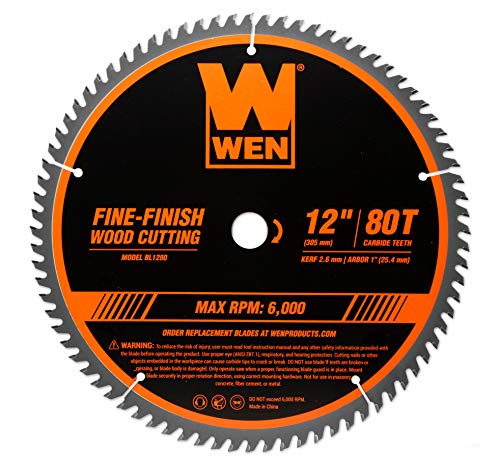
This blade’s precision and versatility make it a standout choice for DIY enthusiasts and weekend woodworkers who need professional-grade results without breaking the bank.
You’ll appreciate the BL1280’s ultra-thin 1/10-inch kerf and 80 carbide-tipped teeth that deliver smooth, splinter-free cuts across hardwoods and softwoods. It’s compatible with most 12-inch miter saws and table saws, running at speeds up to 6000 RPM. The blade’s protective coating fights rust and resin buildup, while heat expansion slots promote accuracy under varying conditions. Whether you’re cutting pine, oak, or cabinet plywood, you’ll get clean, professional cuts that rival more expensive blades.
Best For: DIY woodworkers and hobbyists seeking professional-quality cuts for trim work, cabinetry, and general woodworking projects without investing in premium-priced blades.
Pros:
- Ultra-thin kerf and 80 carbide-tipped teeth deliver exceptionally smooth, splinter-free cuts
- Versatile compatibility with most 12-inch miter and table saws
- Protective coating and heat expansion slots ensure longevity and consistent performance
Cons:
- May not be durable enough for daily professional or heavy-duty use
- Limited to 12-inch saw compatibility only
- Light-duty design may require more frequent replacement under intensive use
Factors to Consider When Choosing a 12″ Blade for Miter Saw
When you’re selecting a 12-inch blade for your miter saw, you’ll need to match the tooth count to your intended purpose – higher counts for fine finishes and lower counts for rough cuts. You should evaluate the blade’s material quality and kerf width, as these factors affect both the precision of your cuts and your saw’s power requirements. Consider how the blade manages heat dissipation and cutting speed, since these features directly impact your work efficiency and the blade’s longevity.
Tooth Count and Purpose
Understanding tooth count is essential when selecting your ideal 12-inch miter saw blade. Lower tooth counts around 32T work best for general-purpose cuts and ripping, while blades with 80T or 100T deliver smoother finishes for detailed work. You’ll want to choose blades with 60 teeth or more when cutting hardwoods and plywood to achieve clean edges with minimal splintering.
Consider an alternating top bevel (ATB) tooth design for your blade, as it helps reduce splintering during fine finish applications. If you’re working on diverse projects, you might benefit from using multiple blades with different tooth counts. This flexibility allows you to switch between aggressive cuts and precision finishing. Remember that thinner kerfs around 1/10 inch complement higher tooth counts by reducing material waste and cutting resistance.
Blade Material Quality
Material quality stands at the forefront of selecting an effective miter saw blade. You’ll want to focus on blades made from tungsten carbide, as they offer superior wear resistance and will last considerably longer than standard options.
Look for blades with protective coatings that shield against heat, rust, and corrosion. These features aren’t just extras – they’re essential for maintaining your blade’s performance over time. Pay attention to the blade’s kerf thickness, as thinner kerfs will give you cleaner cuts with less material waste. You’ll also want to examine the blade’s tooth geometry and construction, as these elements directly impact how well it handles splintering and tear-out. A high-quality blade will consistently perform well across different cutting conditions while efficiently removing chips during operation.
Kerf Width Impact
The blade’s kerf width plays a crucial role in determining your cutting precision and material efficiency. When selecting a 12″ blade for your miter saw, you’ll need to take into account how the kerf width affects your specific projects. Ultra-thin kerfs of 1/10 inch or less will give you cleaner cuts with minimal waste and splintering, making them perfect for finish work and delicate pieces.
While thicker kerfs offer enhanced durability and can handle more demanding cuts, they’ll consume more material and require additional power from your saw. You’ll want to match the kerf width to both your project requirements and your saw’s capabilities. For precise woodworking and detailed trim work, opt for thinner kerfs. Just verify your chosen blade’s specifications align with your miter saw’s design for safe, efficient operation.
Cutting Speed Requirements
When selecting your ideal 12″ miter saw blade, cutting speed requirements deserve careful attention. You’ll need to match your blade’s tooth count to your cutting needs: higher counts around 100 teeth deliver smoother, slower cuts, while 32-tooth blades excel at rapid cutting.
Consider your saw’s RPM rating, which should meet or exceed your blade’s maximum RPM specification (up to 6000 RPM) for safe, peak performance. Your blade’s kerf thickness also affects speed – thinner kerfs around 1/10 inch cut faster with less resistance. If you’re working with hardwoods, you’ll want to feed the material more slowly for clean cuts, while softwoods allow faster speeds. Look for blades with expansion grooves to prevent overheating during extended use, maintaining consistent cutting speeds.
Heat Dissipation Features
Beyond cutting speed, proper heat management in your miter saw blade directly impacts its performance and longevity. You’ll want to look for blades with expansion grooves that help regulate temperature build-up during extended cutting sessions.
Choose blades with optimized kerf width to reduce friction and heat generation, enabling faster cuts while minimizing wear. Tungsten carbide teeth are essential, as they’ll maintain their cutting edge even under high-temperature conditions. To prevent warping and maintain precision, select blades designed with effective heat dispersion features.
Don’t overlook protective coatings on your blade – they’re vital in fighting friction-related heat damage. These coatings will extend your blade’s lifespan and reduce how often you’ll need replacements, saving you money in the long run.
Compatible Wood Types
Selecting your ideal miter saw blade starts with understanding wood compatibility. You’ll find that general-purpose blades work well with both softwoods and hardwoods, making them versatile for cutting pine, oak, and poplar. For premium results with hardwoods and plywood, opt for a fine-finish blade with 80 teeth or more, which reduces tear-out and splintering.
When working with veneered plywood or melamine, you’ll need to evaluate the blade’s tooth design and construction carefully. Ultra-thin kerf blades deliver clean cuts while minimizing waste, making them ideal for precise work. If you’re focused on specific tasks like fine molding, choose specialty blades designed for those applications. Remember that different wood types and composites require different blade characteristics for peak performance.
Price Versus Durability
A smart investment in your miter saw blade balances initial cost against long-term durability. While budget-friendly blades might seem attractive, they often require frequent replacements, which can increase your overall spending. Premium blades made with tungsten carbide typically last three times longer and deliver consistently cleaner cuts.
You’ll find that higher-priced blades engineered with specific tooth geometry and ideal kerf thickness maintain their performance much longer than cheaper alternatives. To determine the best value, consider how often you’ll use the blade and check user reviews that highlight longevity relative to cost. If you’re a frequent woodworker, investing in a quality blade will save you money in the long run, despite the higher upfront cost.