Choosing the right chuck can make or break your woodturning projects. A weak grip wastes time, ruins workpieces, and creates safety risks you don’t want anywhere near a spinning lathe. Whether you’re turning bowls, spindles, or intricate details, the chuck you use matters more than most woodturners realize. These seven options stand out for their holding power, durability, and real-world performance—and what you’ll uncover about each one might change how you work forever.
Quick Overview
- Self-centering chucks with gear-driven jaw systems eliminate manual adjustments, cutting setup time in half while ensuring consistent, reliable grip on every workpiece.
- Steel chucks rated 60–62 HRC resist deformation under high torque, maintaining a firm, stable grip without slipping during demanding cuts.
- Four-jaw chucks like the WEN LA4374 offer both internal and external clamping capacities, gripping a wider variety of workpiece shapes and sizes.
- Nickel-plated or blackened chromium-vanadium steel construction resists corrosion, preserving jaw precision and gripping strength in humid workshop environments over time.
- Matching chuck jaw capacity to your lathe’s swing size prevents clearance issues, ensuring maximum gripping force is applied safely without bed strikes.
| WEN LA4374 4-Jaw Self-Centering Lathe Chuck Set | 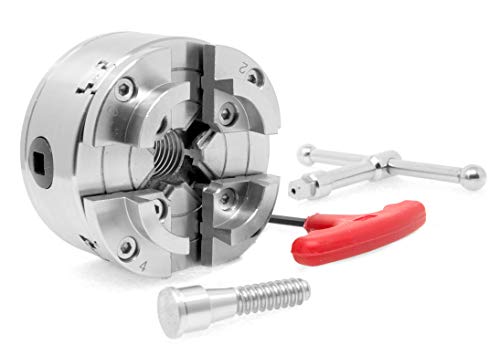 | Best Overall | Chuck Type: 4-jaw self-centering | Thread Size: 1″ × 8 TPI | Chuck Diameter: 3.75 inches | VIEW LATEST PRICE | Read Our Analysis |
| 4-Inch Self-Centering 4-Jaw Wood Lathe Chuck Set |  | Most Versatile | Chuck Type: 4-jaw self-centering | Thread Size: 1″ × 8 TPI or 3/4″ × 16 TPI (adapter included) | Chuck Diameter: 4 inches | VIEW LATEST PRICE | Read Our Analysis |
| Wood Lathe Chuck 3-Inch 3-Jaw with MT Arbor |  | Best Three-Jaw | Chuck Type: 3-jaw self-centering | Thread Size: 1″ × 8 TPI | Chuck Diameter: 3 inches (48 mm) | VIEW LATEST PRICE | Read Our Analysis |
| NOVA Self-Centering Wood Lathe Key Chuck Set |  | Professional Grade | Chuck Type: Multi-jaw self-centering (dovetail, pin, step, wide jaws) | Thread Size: 1″ × 8 TPI or 3/4″ × 16 TPI (adapter included) | Chuck Diameter: 3.5 inches | VIEW LATEST PRICE | Read Our Analysis |
| 3-3/4″ 4-Jaw Self-Centering Wood Lathe Chuck |  | Editor’s Choice | Chuck Type: 4-jaw self-centering (dovetail jaws) | Thread Size: 1″ × 8 TPI or 3/4″ × 16 TPI (adapter included) | Chuck Diameter: 3.75 inches | VIEW LATEST PRICE | Read Our Analysis |
| 3-Inch Self-Centering Wood Lathe Chuck Set |  | Budget-Friendly Pick | Chuck Type: 3-jaw self-centering | Thread Size: 1″ × 8 TPI | Chuck Diameter: 3 inches | VIEW LATEST PRICE | Read Our Analysis |
| ArtyMaster 2″ Mini 3-Jaw Self-Centering Lathe Chuck |  | Best Mini Chuck | Chuck Type: 3-jaw self-centering | Thread Size: M18 × 1.5 mm | Chuck Diameter: 2 inches (42 mm) | VIEW LATEST PRICE | Read Our Analysis |
More Details on Our Top Picks
WEN LA4374 4-Jaw Self-Centering Lathe Chuck Set
If you’re seeking an all-around top performer, the WEN LA4374 4-Jaw Self-Centering Lathe Chuck Set stands out for woodturners who need reliable, precise gripping across a wide range of stock sizes. Its external jaws handle stock from 1¼″ to 2½″, while internal jaws accommodate pilot holes from 1¾″ to 3⅛″. The keyed tightening mechanism and 24-position indexed backplate give you consistent, repeatable setups. It fits WEN models 3420, 3421, 3424, and several others via its 1″ × 8 TPI thread. At 2.27 kg, it’s solidly built without feeling cumbersome on your lathe.
- Chuck Type:4-jaw self-centering
- Thread Size:1″ × 8 TPI
- Chuck Diameter:3.75 inches
- Jaw Capacity:External 1¼″–2½″; internal pilot holes 1¾″–3⅛″
- Weight:2.27 kg
- Included Accessories:Indexed backplate, screw
- Additional Feature:24-position indexed backplate
- Additional Feature:Keyed tightening mechanism
- Additional Feature:Metal construction
4-Inch Self-Centering 4-Jaw Wood Lathe Chuck Set
The DEEFIINE chuck set is most versatile for woodturners who need reliable clamping across a wide range of workpiece sizes. It handles up to 102 mm in diameter and fits both 1-inch × 8 TPI and 3/4-inch × 16 TPI spindle lathes. You get dual-direction jaw installation, letting you switch between positive and negative clamping as your project demands. The chromium-vanadium steel construction with blackened finish resists rust without much upkeep. At 4.1 stars from 249 reviews, it’s a dependable choice backed by a 30-day return policy.
- Chuck Type:4-jaw self-centering
- Thread Size:1″ × 8 TPI or 3/4″ × 16 TPI (adapter included)
- Chuck Diameter:4 inches
- Jaw Capacity:Up to 102 mm workpiece diameter
- Weight:2.07 kg
- Included Accessories:2 wrenches, 3/4″ × 16 TPI adapter
- Additional Feature:Chromium-vanadium steel body
- Additional Feature:Rust-resistant blackened finish
- Additional Feature:Dual-direction jaw installation
Wood Lathe Chuck 3-Inch 3-Jaw with MT Arbor
Woodturners seeking a top three-jaw option will appreciate HAowosi’s 3-inch chuck, which fits any lathe with a 1-inch by 8 TPI spindle. Its self-centering, self-tightening design eliminates repeated calibration, saving you setup time. The reversible stepped jaws handle both internal and external workpieces, giving you genuine versatility. You’ll also get two wrenches plus both MT-1 and MT-2 arbor shanks right out of the box. Built from alloy steel and weighing 1.62 kg, it’s sturdy without being cumbersome. Amazon’s 30-day return guarantee backs your purchase, so you’re not taking any risk trying it out.
- Chuck Type:3-jaw self-centering
- Thread Size:1″ × 8 TPI
- Chuck Diameter:3 inches (48 mm)
- Jaw Capacity:48 mm
- Weight:1.62 kg
- Included Accessories:2 wrenches, MT-1 shank, MT-2 shank
- Additional Feature:MT-1 & MT-2 arbor shanks
- Additional Feature:Self-tightening jaw design
- Additional Feature:No recalibration needed
NOVA Self-Centering Wood Lathe Key Chuck Set
Serious hobbyists and professionals seeking a professional-grade chuck set won’t be disappointed by NOVA’s Self-Centering Wood Lathe Key Chuck Set. Built from high-grade K1045 steel with electric nickel plating, it resists rust and delivers precise, stable performance. You get a complete kit: chuck body, four jaw types, T-Allen wrench, tightening gear key, and a spindle adapter covering 1×8 TPI and 3/4×16 TPI lathes. It handles swings up to 14 inches and bowls up to 12 inches. The self-centering, self-locking mechanism keeps your workpiece secure throughout every cut. VINWOX backs it with a product warranty and Amazon’s 30-day return policy.
- Chuck Type:Multi-jaw self-centering (dovetail, pin, step, wide jaws)
- Thread Size:1″ × 8 TPI or 3/4″ × 16 TPI (adapter included)
- Chuck Diameter:3.5 inches
- Jaw Capacity:Up to 12-inch bowl; 3.5-inch item diameter
- Weight:Not specified
- Included Accessories:2 dovetail jaws, pin jaw, step jaw, wide jaw, gear key, T-Allen wrench, worm-screw chuck, adapter
- Additional Feature:Electric nickel-plated body
- Additional Feature:Ground jaw teeth/guides
- Additional Feature:5 interchangeable jaw types
3-3/4″ 4-Jaw Self-Centering Wood Lathe Chuck
For versatile turning projects, this editor’s choice chuck delivers everything hobbyists and seasoned woodturners need. You get internal jaw capacity from 1½” to 2⅞” and external grip for pilot holes from 2 5/32″ to 3 5/8″, covering bowls, cups, vases, and spindles. The self-locking system guarantees a strong positive grip, while the T-handle enables one-handed operation. It fits 1×8 TPI or ¾×16 TPI spindles, making it compatible with Jet, Delta, Grizzly, and similar lathes up to 14-inch swing. The included screw chuck and spring-loaded center punch expand your setup further.
- Chuck Type:4-jaw self-centering (dovetail jaws)
- Thread Size:1″ × 8 TPI or 3/4″ × 16 TPI (adapter included)
- Chuck Diameter:3.75 inches
- Jaw Capacity:Internal 1½″–2⅞″; external pilot holes 2 5/32″–3 5/8″
- Weight:Not specified
- Included Accessories:2 dovetail jaws, gear key, T-Allen wrench, screw chuck, adapter, spring-loaded center punch
- Additional Feature:Spring-loaded center punch
- Additional Feature:One-handed T-handle operation
- Additional Feature:K1045 alloy steel body
3-Inch Self-Centering Wood Lathe Chuck Set
Whether you’re a hobbyist or a beginner turner, this budget-friendly pick — the 3-Inch Self-Centering Wood Lathe Chuck Set — delivers reliable performance without breaking the bank. Its CNC-cast steel construction guarantees precision and durability, while the self-centering 3-jaw design handles both round and square workpieces. You can install the jaws in positive or negative directions, and adjust them independently for a superior grip. The 1×8 TPI threaded collet makes mounting and dismounting quick and easy. At 1.11 kg, it’s compatible with wood lathes, grinders, and milling machines, and it backs you with a 30-day return guarantee.
- Chuck Type:3-jaw self-centering
- Thread Size:1″ × 8 TPI
- Chuck Diameter:3 inches
- Jaw Capacity:Up to 3 inches diameter
- Weight:1.11 kg
- Included Accessories:Installation tools
- Additional Feature:CNC-cast precision body
- Additional Feature:Handles round/square workpieces
- Additional Feature:Multi-machine compatibility
ArtyMaster 2″ Mini 3-Jaw Self-Centering Lathe Chuck
Woodturners seeking a top-tier mini chuck will find the ArtyMaster 2″ Mini 3-Jaw Self-Centering Lathe Chuck worth considering, especially if you’re working with compact setups or smaller projects. It clamps workpieces ranging from 3–42 mm and braces up to 50 mm, giving you solid versatility despite its small size. The CNC-machined alloy steel construction delivers accuracy and durability, while the self-centering jaws guarantee consistent alignment. It fits the ArtyMaster WM101 lathe and any wood lathe with an M18 × 1.5 mm spindle thread. At 0.43 kg, it’s lightweight yet capable, and it’s backed by a 30-day return guarantee.
- Chuck Type:3-jaw self-centering
- Thread Size:M18 × 1.5 mm
- Chuck Diameter:2 inches (42 mm)
- Jaw Capacity:Clamping 3–42 mm; bracing 30–50 mm
- Weight:0.43 kg
- Included Accessories:Hand-drill connector (0.4 in)
- Additional Feature:M18 × 1.5 mm thread
- Additional Feature:Hand-drill attachment connector
- Additional Feature:CNC-machined alloy steel
Factors to Consider When Choosing a Chuck for a Wood Lathe
When choosing a chuck for your wood lathe, you’ll want to evaluate several key factors that directly impact performance and compatibility. Consider the jaw count, clamping capacity range, thread size compatibility, and body material to guarantee the chuck meets your specific turning needs. A reliable self-centering mechanism is also essential, as it saves time and improves accuracy across your projects.
Chuck Jaw Count
How many jaws your chuck has directly shapes what you can turn and how accurately you can hold it. A 3-jaw chuck self-centers automatically, making it ideal for round stock since all jaws move simultaneously. You get one fixed clamping position, which limits versatility but speeds up setup.
A 4-jaw chuck gives you independent jaw control, letting you grip irregular or non-circular workpieces with precision. You also gain up to 24 indexed positions for dialing in exact alignment. Many 4-jaw designs support positive and negative jaw installation, enabling both external and internal gripping — something 3-jaw chucks rarely offer.
The tradeoff is added weight, cost, and setup time. Match your jaw count to the complexity of work you actually plan to turn.
Clamping Capacity Range
Once you’ve settled on jaw count, the next thing to nail down is clamping capacity range — because even the right jaw configuration becomes useless if the chuck can’t grip your actual workpiece. Choose a chuck whose jaw capacity exceeds your maximum intended turning diameter, checking both the external range and the internal range for pilot holes. Confirm the chuck’s maximum recommended swing matches your lathe’s swing capacity. Thread compatibility matters too — a mismatched spindle thread immediately limits usable capacity, regardless of what the jaw range advertises. Self-centering jaws maintain consistent clamping across the full capacity range without manual readjustment, making them the practical choice for most turners. Finally, verify the chuck’s material and construction can sustain clamping force at the upper end of its range without deforming.
Thread Size Compatibility
Thread size compatibility might seem like a minor detail, but a mismatched thread between your chuck and lathe spindle means the chuck simply won’t mount — full stop. Start by confirming your spindle’s diameter — typically 1 inch or 3/4 inch — then verify the thread pitch, whether that’s 1 × 8 TPI or 3/4 × 16 TPI. You’ll also want to check that the thread standard matches, since UNC and metric threads aren’t interchangeable and will cross-thread if forced. If your chuck and lathe don’t share the same spec, look for chucks that include adapters bridging 1 × 8 TPI and 3/4 × 16 TPI configurations. Finally, confirm your spindle’s length can physically accommodate the chuck’s thickness without interference, particularly with larger or double-threaded designs.
Chuck Body Material
The material a chuck’s body is made from directly affects its longevity, performance under load, and maintenance demands. High-grade alloy steel, like K1045, outperforms cast iron and low-grade steel by offering superior strength and wear resistance—critical when you’re gripping high-torque workpieces repeatedly. Steel chucks rated at 60–62 HRC won’t deform under pressure, keeping your grip consistent over time.
You’ll also benefit from nickel-electric plating, which fights corrosion in humid workshop conditions and cuts down on maintenance. CNC-cast steel bodies deliver tight tolerances and reliable jaw alignment, so your workpiece positioning stays repeatable across sessions. As a bonus, alloy steel chucks typically weigh less than cast-iron versions, making tool changes faster and less physically demanding on you.
Self-Centering Mechanism
When choosing a chuck, a self-centering mechanism can cut your setup time in half by automatically locating the workpiece’s geometric center as you tighten the jaws. A gear-driven system moves all jaws inward simultaneously, eliminating manual adjustment and keeping your workpiece perfectly centered every time.
Look for a 2-to-1 gear ratio, which converts a small handle turn into enough clamping force without over-tightening. Positive-lock or self-locking gear designs keep the jaws from loosening during rotation, maintaining concentricity under load—critical when you’re spinning wood at speed.
If you need versatile positioning, choose a chuck with an indexed backplate, like a 24-position design, which lets you rotate a single plate to align jaws in preset positions quickly and accurately.
Included Accessories Value
Beyond the self-centering mechanism, what’s packed in the box can make or break a chuck’s overall value. Count the wrenches and adapters included, since each extra tool reduces separate purchases. More pieces mean more savings upfront.
Check whether the set offers both internal and external jaws, as that expands the range of workpiece sizes and shapes you can handle without upgrading immediately. A built-in screw chuck or pin jaw adds versatility for small or delicate pieces, eliminating the need for extra accessories.
Look for a T-handle or gear key, which supports one-handed operation and improves safety during quick changes. Also assess whether dovetail jaws or a spring-loaded center punch comes included, since both enhance precision and stability for specific turning projects you’ll tackle later.
Lathe Swing Size
Matching your chuck to your lathe’s swing size keeps workpieces rotating safely without striking the bed or tailstock. Swing size refers to the maximum diameter a workpiece can rotate without hitting the lathe’s bed or tailstock, measured in inches or millimeters.
Choose a chuck whose maximum external jaw capacity exceeds your lathe’s swing radius. For a 12-inch swing lathe, you’ll need a chuck gripping up to at least a 6-inch radius. If you’re working with larger swing sizes, invest in heavier, more robust chucks—they maintain rigidity and prevent vibration at wider diameters. Also, verify that your chuck’s overall diameter, including any adapters, doesn’t reduce your lathe’s usable swing clearance, as that compromise defeats the purpose of matching sizes correctly.
Mounting and Dismounting Speed
How quickly you can swap a chuck in and out directly impacts your workflow, especially during long sessions with frequent workpiece changes. Threaded-on chucks with a quick-release lever take under 10 seconds to remove or install, compared to 30–45 seconds for keyed designs. If you use a self-centering chuck with a single hand-tightened knob, you’ll lock it in one rotation, cutting time in half versus multi-step mechanisms.
Chucks with a built-in T-handle or Allen-key slot let you work one-handed, eliminating extra tools. Adding a 1-inch × 8 TPI to ¾-inch × 16 TPI adapter saves up to 15 seconds per spindle change. A spring-loaded or screw-type center punch that mounts in one motion further tightens your changeover time.