Did you know that over 80% of woodworkers consider box joints one of the strongest wood joining methods? If you’re looking to create these precise, interlocking joints on your table saw, you’ll need a reliable jig to guide your work. While there are countless options available, four specific box joint jigs stand out for their exceptional performance, durability, and user-friendly features. Let’s explore which one might be the perfect fit for your workshop.
Woodhaven 4555 Box Joint Jig


If you’re seeking professional-grade box joint precision, the Woodhaven 4555 Box Joint Jig stands out with its innovative design where the work moves over the jig rather than the other way around. This USA-made jig handles joints from 1/8 to 13/16 inches and includes a 24-inch aluminum Ultra Track with adjustable pins to prevent slippage.
You’ll appreciate the replaceable sub-fences and bit/blade cutout that enhance accuracy. While some users note missing T-slot nuts and initial setup time, the lifetime guarantee adds value. Though it requires careful measurement and adjustment, this 5.64-pound jig delivers reliable results when properly calibrated.
Best For: Woodworking enthusiasts and professionals seeking precise box joints who are willing to invest time in setup and have experience with careful measurements and adjustments.
Pros:
- Innovative design where work moves over the jig reduces errors
- Versatile joint size range (1/8″ to 13/16″) with adjustable aluminum pins
- Lifetime guarantee and made in USA with quality materials
Cons:
- Missing components like T-slot nuts reported by some users
- Requires significant time investment for initial setup and adjustments
- Higher price point compared to basic box joint jigs
Router Table Box Joint Jig with Three Finger Widths

Woodworkers seeking versatility in their box joint projects will appreciate the ROCKLER Router Table Box Joint Jig‘s three finger width options. You’ll get ¼”, ⅜”, and ½” brass indexing keys for precise, uniform spacing in your joinery work.
The jig’s melamine-coated MDF platform and glass-filled nylon sled deliver smooth operation while preventing tear-out. You can lock it securely into your ¾” miter slot with the included soft-grip knobs. The long skis maintain squareness to your router bit, and built-in tabs help you stop at cut ends. For best results, keep your workspace clean and use digital calipers for setup accuracy.
Best For: Woodworking enthusiasts and hobbyists who regularly make boxes and drawers of varying sizes and need precise, repeatable finger joints across multiple project dimensions.
Pros:
- Versatile three-width finger joint capability (¼”, ⅜”, ½”) eliminates need for multiple jigs
- Smooth-sliding melamine coating and glass-filled nylon construction reduces friction and tear-out
- Secure locking mechanism with soft-grip knobs ensures stable, accurate cuts
Cons:
- Requires careful initial setup and calibration for optimal results
- Limited to ¾” miter slot compatibility
- Additional setup blocks may be needed for maximum precision
POWERTEC Adjustable Box Joints Jig (71759)

The POWERTEC Adjustable Box Joints Jig (71759) offers versatility for both table saw and router table users who need precise box and finger joints. You’ll get a complete package with everything required for setup, including the body assembly, MDF sub fence, guide bar, and multiple stop plates.
The jig’s wide fence securely clamps your workpieces while the small adjustment knob lets you control pin plate distance with precision. You’ll appreciate the flexible pin plates that guarantee peak cutting without damaging your wood. For safety and convenience, the system includes a blade guard and clamp guard, making it easier to handle large pieces while maintaining accuracy.
Best For: Woodworking enthusiasts and craftspeople who need precise box joints and finger joints for their table saw or router table projects.
Pros:
- Complete kit includes all necessary components for immediate setup and use
- Wide fence and adjustment knob allow for precise control and secure workpiece clamping
- Versatile design works with both table saws and router tables
Cons:
- Requires initial setup time to properly align and adjust components
- MDF sub fence may need eventual replacement with prolonged use
- Limited to right-angle joints only
INCRA I-BOX Jig for Box Joints
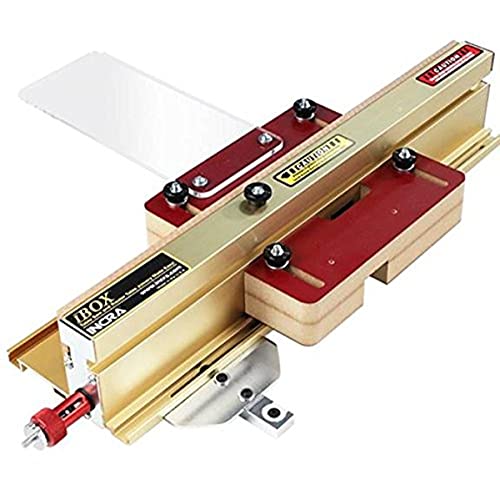
Advanced woodworkers seeking professional-grade box joints will find exceptional value in INCRA’s I-BOX jig, which offers micro-adjustable precision from 1/8″ to 3/4″ pin widths.
You’ll appreciate its versatility on both table saws and router tables, with a reversible design that adapts to different cutters. The dual-pitch lead screw guarantees precise adjustments, while the GlideLOCK miter bar fits standard slots. The included MDF sub-fence reduces tearout, and you can create specialty joints like center-keyed and splined patterns. With a 4.6-star rating across 917 reviews, it’s a premium tool that delivers consistent, professional results.
Best For: Advanced woodworkers and professionals who frequently create box joints and need precise, repeatable results across various project types.
Pros:
- Exceptional precision with micro-adjustable settings from 1/8″ to 3/4″ pin widths
- Versatile compatibility with both table saws and router tables
- Enables specialty joints like center-keyed and splined patterns
Cons:
- Higher price point compared to basic box joint jigs
- Initial setup requires careful attention and practice
- Limited to material thickness between 1/4″ to 1″ only
Factors to Consider When Choosing a Box Joint Jig for Table Saw
When selecting a box joint jig for your table saw, you’ll need to evaluate several critical features to guarantee you’re making a worthwhile investment. You’ll want to assess the build quality and materials used, compare prices against included features, check setup requirements, verify the range of cutting widths supported, and confirm compatibility with your saw‘s miter gauge. These factors will directly impact your jig’s longevity, value, ease of use, versatility, and overall performance in your woodworking projects.
Material Quality and Durability
Material quality and durability stand as foundational factors in selecting a box joint jig that’ll serve you reliably for years to come. You’ll want to look for jigs constructed from aluminum and MDF, as these materials provide an ideal balance between durability and ease of handling.
When evaluating durability, check for replaceable sub-fences made from robust materials and low-friction coatings on sliding surfaces. These features greatly reduce wear and extend your jig’s lifespan. Pay close attention to the adjustment mechanisms, as they’re essential for maintaining precise alignment through repeated use.
Don’t overlook the manufacturer’s warranty – a lifetime guarantee against defects often indicates superior material quality and construction. This confidence from the manufacturer suggests you’re investing in a tool that’ll withstand extensive workshop use.
Price Vs Feature Balance
Finding the sweet spot between price and features requires careful consideration of your woodworking needs and budget. You’ll want to assess whether premium features like advanced adjustability settings and multiple joinery options justify a higher price tag for your specific projects.
When comparing jigs, you’ll notice that higher-priced models often offer enhanced precision, easier setup, and better user support. Look for models that include valuable components and versatile settings that eliminate the need for additional tools. While budget-friendly options might seem attractive initially, they may lack vital features that guarantee accuracy and efficiency. Review user ratings and experiences to determine if spending more will genuinely improve your woodworking results. Remember that investing in a well-equipped jig can save you time and frustration in the long run.
Ease of Setup
A well-designed box joint jig can transform your setup experience from frustrating to effortless. Look for models featuring micro-adjustments or dual-pitch lead screws that’ll help you dial in precise settings quickly without the trial-and-error process common to basic jigs.
You’ll want a jig that fits standard miter slots, making it simple to mount and adjust on your table saw. User-friendly features like intuitive adjustment knobs and secure locking mechanisms will make your setup process smoother. If you’re new to box joints, choose a jig that comes with clear instructional materials.
Don’t overlook the importance of adjustable stop plates and templates for different joint widths. These features guarantee you’ll achieve consistent results once you’ve locked in your settings, saving time on future projects.
Cutting Width Range
The cutting width range of your box joint jig directly impacts the versatility of your woodworking projects. You’ll find most quality jigs offer adjustable widths from 1/8 inch to 13/16 inch, giving you flexibility for different joint sizes.
When selecting your jig, look for one that matches your typical lumber dimensions. Models that cut up to 3/4 inch wide will handle most standard woodworking tasks. If you need more options, consider jigs with interchangeable components that let you switch between 1/4 inch to 1/2 inch finger widths.
Remember that precise width adjustment capabilities are essential for creating tight-fitting joints. Choose a jig with a cutting range that aligns with your project requirements to guarantee you’ll get the exact fit you need for strong, professional-looking box joints.
Miter Gauge Compatibility
Since most table saws come with standard miter gauge slots, you’ll need a box joint jig that fits securely within these dimensions, typically ranging from 0.740 to 0.762 inches wide. Look for jigs that feature locking knobs or hardware specifically designed for ¾-inch miter slots, as these will provide the stability you need during operation.
Your box joint jig should easily attach to various miter gauges and slide smoothly along the slot while maintaining perfect squareness. This smooth movement is essential for achieving precise, error-free cuts. Consider investing in a jig with adjustable components that can accommodate different miter gauge designs – you’ll appreciate the added versatility when working with various table saw setups or if you need to switch between different miter gauges.
Storage and Portability
When choosing a box joint jig, storage and portability features can greatly impact your workshop efficiency. You’ll want to evaluate lightweight options like the Woodhaven 4555, which at 5.64 pounds won’t strain you during transport or storage handling.
Look for jigs with compact dimensions similar to the Router Table Box Joint Jig’s 12.99 x 11.26 x 3.7-inch package size, as they’ll fit easily into your storage space. If you’re working at multiple locations, select a jig with travel-friendly features and removable components. Some models can be disassembled for more compact storage, helping you maintain an organized workspace. Don’t forget to check if your chosen jig includes a carrying case, which will protect the components and make transportation more convenient.
Safety Features Design
Prioritizing safety features in your box joint jig selection can prevent workshop accidents and guarantee peace of mind during operation. You’ll want to ascertain your chosen jig includes a proper blade guard to protect your hands from accidental contact while making cuts.
Look for models that incorporate reliable clamp guards to keep your workpiece firmly in place. The jig should feature adjustable stop plates that let you control cutting depth and position with precision. You’ll also benefit from choosing a jig with straightforward setup mechanisms, as this reduces the likelihood of errors when handling larger pieces. Don’t overlook the importance of smooth adjustment controls – they’ll help you fine-tune your joint dimensions safely and accurately, allowing you to work with confidence while minimizing risks.
Precision Adjustment Mechanisms
A well-designed precision adjustment mechanism serves as the cornerstone of any reliable box joint jig. When selecting your jig, look for one with dual-pitch lead screws that’ll let you make both quick adjustments and fine-tuned modifications to pin widths.
You’ll want interchangeable indexing keys that provide consistent spacing options for different joint sizes. Pay attention to how the jig maintains squareness to your cutting tool – this is vital for clean, tear-out-free edges. The best jigs come with setup tools like reference blocks or height gauges that help you dial in exact measurements.
Don’t overlook the importance of micro-adjustment knobs – they’re essential for achieving those perfectly tight-fitting joints. The more precise control you have over these adjustments, the better your final results will be.