
Miter saws look simple until you’re staring at a warped crown molding cut and wondering where everything went wrong. You’ve probably narrowed it down to a few models but can’t pull the trigger — and that hesitation makes total sense. The wrong saw doesn’t just waste money; it wastes every project after it. Stick around, because what separates the pretenders from the ones serious woodworkers actually trust comes down to details most buyers never check.
| DOVAMAN 12-Inch Dual-Bevel Compound Sliding Miter Saw |  | Best Overall | Motor Power: 15 Amp, 1800 W, 3800 RPM | Blade Size & Teeth: 12-inch, 40-tooth TCT | Bevel Type & Range: Dual bevel, 0°–45° | VIEW LATEST PRICE | Read Our Analysis |
| NOVORIK 10″ Single Bevel Compound Sliding Miter Saw |  | Budget-Friendly Pick | Motor Power: 15 Amp, 1800 W, 4000 RPM | Blade Size & Teeth: 10-inch, 40-tooth TCT | Bevel Type & Range: Single bevel, 0°–45° | VIEW LATEST PRICE | Read Our Analysis |
| DEWALT 12-Inch Double Bevel Sliding Miter Saw (DWS779) |  | Professional Grade | Motor Power: 15 Amp, 3800 RPM | Blade Size & Teeth: 12-inch, 32-tooth | Bevel Type & Range: Double bevel, 0°–49° both sides | VIEW LATEST PRICE | Read Our Analysis |
| SKIL 10″ Dual Bevel Sliding Compound Miter Saw-MS6305-00 | 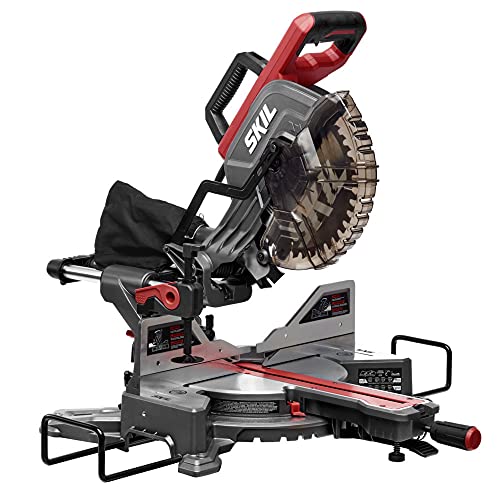 | Most Portable | Motor Power: 15 Amp, 1800 W, 4800 RPM | Blade Size & Teeth: 10-inch, 40-tooth HSS | Bevel Type & Range: Dual bevel, 0°–48° left/right (4 positive stops) | VIEW LATEST PRICE | Read Our Analysis |
| Metabo HPT 10-Inch Single Bevel Compound Miter Saw (C10FCG2) |  | Lightest Design | Motor Power: 15 Amp, 1950 W, 5000 RPM | Blade Size & Teeth: 10-inch, 40-tooth TCT | Bevel Type & Range: Single bevel, 0°–45° left only | VIEW LATEST PRICE | Read Our Analysis |
| DEWALT 12-Inch Miter Saw 15-Amp Single Bevel Compound (DWS715) |  | Best For Beginners | Motor Power: 15 Amp, 1800 W, 4000–4500 RPM | Blade Size & Teeth: 12-inch, 80-tooth stainless steel | Bevel Type & Range: Single bevel, 0°–48° left, 0°–3° right | VIEW LATEST PRICE | Read Our Analysis |
| DWT 10″ Sliding Compound Miter Saw with 3 Blades | 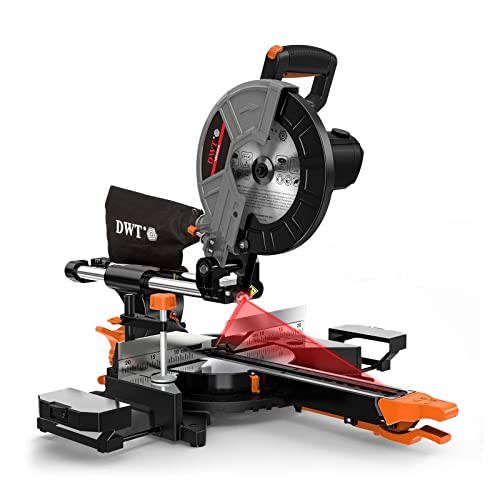 | Best Value | Motor Power: 15 Amp, 2000 W, 3200–4500 RPM (dual speed) | Blade Size & Teeth: 10-inch, 40-tooth (×2) + 48-tooth TCT (×1) | Bevel Type & Range: Single bevel, 0°–45° | VIEW LATEST PRICE | Read Our Analysis |
| 10-Inch Sliding Compound Miter Saw with Extension Table | 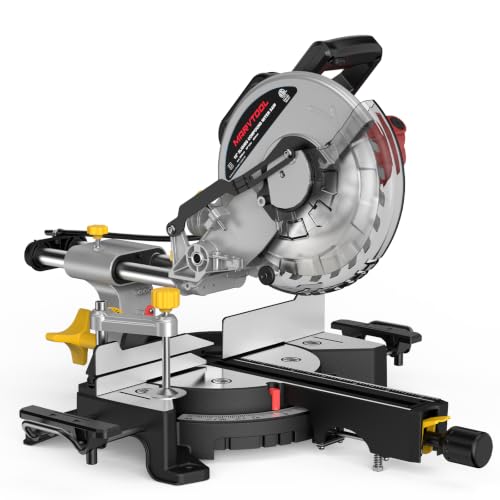 | Most Compact | Motor Power: 15 Amp, 1900 W, 5000 RPM | Blade Size & Teeth: 10-inch, 36-tooth alloy steel | Bevel Type & Range: Single bevel, 0°–45° | VIEW LATEST PRICE | Read Our Analysis |
| Evolution R185SMS+ Multi-Material Sliding Miter Saw |  | Most Versatile | Motor Power: 10 Amp, 1500 W | Blade Size & Teeth: 7-1/4-inch, 60-tooth TCT | Bevel Type & Range: Single bevel, 0°–45° | VIEW LATEST PRICE | Read Our Analysis |
| WEN 12-Inch Sliding Compound Miter Saw (MM1213T) |  | Editor’s Choice | Motor Power: 15 Amp, 3800 RPM | Blade Size & Teeth: 12-inch, 48-tooth carbide-tipped | Bevel Type & Range: Dual bevel, ±45° | VIEW LATEST PRICE | Read Our Analysis |
More Details on Our Top Picks
DOVAMAN 12-Inch Dual-Bevel Compound Sliding Miter Saw
Maybe you’ve wrestled with a flimsy miter saw that couldn’t hold an angle — the DOVAMAN 12-inch stands above the rest for good reason. Here’s the thing: a 15-amp pure-copper motor pushing 3,800 RPM doesn’t apologize to hardwood. Nine preset stops keep your angles honest without fussing. The laser guide means you’re cutting lines, not guessing at them. Obviously, dual-bevel matters when you’re trimming crown molding and don’t want to flip boards constantly. At 53.9 pounds, it’s not a featherweight, but it’s stable. This one’s for you if you’re done babysitting a budget saw that fights back.
- Motor Power:15 Amp, 1800 W, 3800 RPM
- Blade Size & Teeth:12-inch, 40-tooth TCT
- Bevel Type & Range:Dual bevel, 0°–45°
- Miter Range & Stops:0°–45° left/right, 9 positive stops
- Weight & Dimensions:53.9 lb; 35 × 22 × 21 in
- Warranty:30-day voluntary return guarantee; limited warranty
- Additional Feature:Ambidextrous operation design
- Additional Feature:9 preset angle stops
- Additional Feature:Laser guide included
NOVORIK 10″ Single Bevel Compound Sliding Miter Saw
If your budget’s tight but your project list isn’t, the NOVORIK 10″ Single Bevel Compound Sliding Miter Saw deserves a hard look. Here’s the thing — single-bevel means you’ll flip your workpiece for opposing angles, which honestly isn’t a dealbreaker for most weekend warriors. You’re getting a 15-amp motor, 4,000 rpm, and a laser guide that tracks your cut in real time. Miter stops hit 0°, 15°, 22.5°, 30°, and 45° both directions. Obviously, it won’t out-feature the DOVAMAN, but at 33.9 pounds, you’re carrying real capability without carrying a premium price. Dust port, clamps, side supports — it’s thoughtfully equipped. Pull the trigger.
- Motor Power:15 Amp, 1800 W, 4000 RPM
- Blade Size & Teeth:10-inch, 40-tooth TCT
- Bevel Type & Range:Single bevel, 0°–45°
- Miter Range & Stops:–45°/0°/+45°, 5 positive stops (0°, 15°, 22.5°, 30°, 45°)
- Weight & Dimensions:33.9 lb; 28.3 × 15 × 18 in
- Warranty:2-year manufacturer warranty; 30-day return
- Additional Feature:Vacuum-compatible dust port
- Additional Feature:Cuts wood, plastic, metal
- Additional Feature:Real-time laser tracking
DEWALT 12-Inch Double Bevel Sliding Miter Saw (DWS779)
Who needs a saw that keeps up with a professional’s pace without making you fight it every step of the way? You do — especially if you’re cutting crown molding, stacking baseboards, or working through dimensional lumber all afternoon. The DWS779‘s 15-amp motor hits 3,800 RPM without breaking a sweat. You get 60° right and 50° left miter range, double bevel to 49° both ways, and fences tall enough for 7½-inch crown. Obviously, 56 pounds isn’t light. But here’s the thing — if you’re serious about clean, accurate cuts consistently, this DEWALT makes that decision feel like a no-brainer.
- Motor Power:15 Amp, 3800 RPM
- Blade Size & Teeth:12-inch, 32-tooth
- Bevel Type & Range:Double bevel, 0°–49° both sides
- Miter Range & Stops:60° right / 50° left, 10 positive stops
- Weight & Dimensions:56 lb; 21 × 17 × 17 in
- Warranty:3-year limited warranty
- Additional Feature:75%+ dust capture
- Additional Feature:Linear ball bearing rails
- Additional Feature:Tall sliding fences
SKIL 10″ Dual Bevel Sliding Compound Miter Saw-MS6305-00
Portable and powerful, the SKIL MS6305-00 is the most portable saw on this list without sacrificing serious capability. At 39.4 pounds with a built-in carrying handle, you’re actually moving this thing between jobsites without throwing your back out. The 15-amp motor hits 4,800 RPM, and you’re getting dual bevel with positive stops at 45° both directions. Here’s the thing — that LED Shadow Line beats a laser for precision cuts every single time. Obviously, it won’t replace a 12-inch saw for massive stock, but for 2×12s at 90° and 2×8s at 45°, you’re completely covered. This one’s yours if portability matters.
- Motor Power:15 Amp, 1800 W, 4800 RPM
- Blade Size & Teeth:10-inch, 40-tooth HSS
- Bevel Type & Range:Dual bevel, 0°–48° left/right (4 positive stops)
- Miter Range & Stops:±50° left/right, 11 positive stops
- Weight & Dimensions:39.4 lb; 35.43 × 22.44 × 14.17 in
- Warranty:3-year limited warranty
- Additional Feature:LED Shadow Line cutting
- Additional Feature:4,800 RPM speed
- Additional Feature:Built-in carrying handle
Metabo HPT 10-Inch Single Bevel Compound Miter Saw (C10FCG2)
You want the lightest design without sacrificing serious cutting power — that frustration is real, and the Metabo HPT C10FCG2 gets it. At just 24 pounds, you’re hauling this thing one-handed to job sites without questioning your life choices. Here’s the thing — the 15-amp motor pushes 5,000 RPM, so lightweight doesn’t mean underpowered. You get 52° miter range left and right, plus the Xact Cut shadow line keeps your blade placement honest. Obviously, single-bevel limits you versus dual-bevel options. But if you’re doing straightforward woodworking and want portability plus a five-year warranty, this one’s genuinely smart.
- Motor Power:15 Amp, 1950 W, 5000 RPM
- Blade Size & Teeth:10-inch, 40-tooth TCT
- Bevel Type & Range:Single bevel, 0°–45° left only
- Miter Range & Stops:0°–52° left/right, adjustable bevel stops
- Weight & Dimensions:24.2 lb; 23.6 × 18.3 × 21.8 in
- Warranty:5-year limited warranty
- Additional Feature:5,000 RPM no-load
- Additional Feature:Xact Cut shadow line
- Additional Feature:Ultra-lightweight 24 lb
DEWALT 12-Inch Miter Saw 15-Amp Single Bevel Compound (DWS715)
If you’re just getting your feet wet with woodworking, the DEWALT DWS715 is genuinely hard to argue against. Here’s the thing — 15 amps and 4,000 RPM means you’re not babying this saw through thick lumber. It handles 2×8s at 90° and 2×6s at 45° without complaint. The stainless-steel miter detent plate with 14 positive stops keeps your angles honest, and that cam lock actually locks. Obviously, single-bevel limits you slightly versus dual-bevel models, but for most cuts you’ll actually make? You won’t notice. If you want reliable, repeatable results without overthinking it, just buy this one.
- Motor Power:15 Amp, 1800 W, 4000–4500 RPM
- Blade Size & Teeth:12-inch, 80-tooth stainless steel
- Bevel Type & Range:Single bevel, 0°–48° left, 0°–3° right
- Miter Range & Stops:0°–90°, 14 positive stops
- Weight & Dimensions:42.77 lb; 26.77 × 21.85 × 18.9 in
- Warranty:Limited manufacturer warranty; 30-day return
- Additional Feature:14 positive miter stops
- Additional Feature:80-tooth blade included
- Additional Feature:Machined base fence
DWT 10″ Sliding Compound Miter Saw with 3 Blades
Budget-minded woodworkers get serious cutting performance for a surprisingly reasonable outlay with the DWT HM1031A. Here’s the thing — you’re not sacrificing much. Dual speeds, 3200 and 4500 RPM, let you match the tool to your material. Three TCT blades ship in the box, including a 48-tooth multifunction blade. That’s genuinely useful. The laser guide tracks your cut in real time, so you’re not guessing. All right, it’s not a DEWALT. Honest admission. But if you’re cutting wood and plastic on a budget, this saw fits your shop without emptying your wallet. Twelve-month warranty seals it.
- Motor Power:15 Amp, 2000 W, 3200–4500 RPM (dual speed)
- Blade Size & Teeth:10-inch, 40-tooth (×2) + 48-tooth TCT (×1)
- Bevel Type & Range:Single bevel, 0°–45°
- Miter Range & Stops:–45°/0°/+45°, positive stops at 0°, 15°, 22.5°, 30°, 45°
- Weight & Dimensions:Not specified
- Warranty:12-month warranty; 30-day return
- Additional Feature:Dual-speed motor settings
- Additional Feature:Three blades included
- Additional Feature:35 mm vacuum port
10-Inch Sliding Compound Miter Saw with Extension Table
Compact enough to haul to any jobsite, this 10-inch sliding miter saw punches well above its weight class. At just 25.6 pounds, you’re not throwing out your back loading it into a truck. The 15-amp motor hits 5,000 RPM, handling wood, laminates, and soft metal without complaint. Here’s the thing — single bevel cuts up to 45 degrees with miter range matching that, so you’ve got compound angles covered. The transparent blade guard keeps your sightlines clean, and two extension tables mean longer boards don’t become your problem. Two-year warranty, 24/7 support. If you want capable and portable, this one’s yours.
- Motor Power:15 Amp, 1900 W, 5000 RPM
- Blade Size & Teeth:10-inch, 36-tooth alloy steel
- Bevel Type & Range:Single bevel, 0°–45°
- Miter Range & Stops:0°–45° left
- Weight & Dimensions:25.6 lb; 29 × 18 × 16 in
- Warranty:2-year limited warranty; 30-day return
- Additional Feature:5,000 RPM no-load
- Additional Feature:Dual extension tables
- Additional Feature:Ultra-lightweight 25.6 lb
Evolution R185SMS+ Multi-Material Sliding Miter Saw
Maybe you’ve been wrestling with the most versatile tool dilemma — one saw for everything versus separate tools for every material. The Evolution R185SMS+ quietly solves that argument. Its patented multi-material technology cuts steel, aluminum, wood with embedded nails, plastic, and composites using one 60-tooth TCT blade. Now, here’s the thing — minimal sparks, heat, and burrs mean you’re not babysitting every cut. The brushless 1500W motor with an optimized gearbox protects both blade and motor long-term. You also get a laser guide, dust bag, and clamp included. If you work across materials constantly, this one’s obviously built for you.
- Motor Power:10 Amp, 1500 W
- Blade Size & Teeth:7-1/4-inch, 60-tooth TCT
- Bevel Type & Range:Single bevel, 0°–45°
- Miter Range & Stops:0°–50°
- Weight & Dimensions:48 × 24 × 12 in (weight not specified)
- Warranty:3-year limited warranty; 30-day return
- Additional Feature:Cuts steel/aluminum/wood
- Additional Feature:Minimal sparks/heat/burrs
- Additional Feature:Brushless motor design
WEN 12-Inch Sliding Compound Miter Saw (MM1213T)
If you’re chasing real dual-bevel sliding performance without a brutal price tag, this one’s our editor’s choice. Look, you’ve probably been burned by budget tools before — we get it. Here’s the thing: the MM1213T swings ±45° both ways, hits 3800 RPM through a 15-amp motor, and crosscuts boards up to 13 inches wide. That’s legitimate capacity. You get laser guidance, a dust bag, adjustable fences, and a quick-clamp — nothing missing. Obviously it’s not a Dewalt. But if you’re a serious weekend woodworker who wants real capability without financing a tool, this one’s genuinely yours.
- Motor Power:15 Amp, 3800 RPM
- Blade Size & Teeth:12-inch, 48-tooth carbide-tipped
- Bevel Type & Range:Dual bevel, ±45°
- Miter Range & Stops:±45°, 5 positive stops (0°, 15°, 22.5°, 30°, 45°)
- Weight & Dimensions:35 × 23.63 × 19.25 in (weight not specified)
- Warranty:2-year limited warranty; 30-day return
- Additional Feature:13-inch crosscut capacity
- Additional Feature:48-tooth carbide blade
- Additional Feature:Quick-clamp assembly
Factors to Consider When Choosing Compound Sliding Miter Saws
Picking the right compound sliding miter saw feels overwhelming when every spec sheet looks the same and every brand claims to be “professional grade.” Here’s the thing — five factors actually move the needle: blade size (10-inch vs. 12-inch changes your crosscut capacity dramatically), motor power (look for at least 15 amps if you’re regularly chewing through hardwoods), bevel and miter range (wider angles mean more flexibility for crown molding and complex trim work), single vs. dual bevel (dual saves you from flipping your workpiece, which sounds minor until you’re mid-project), and sliding rail capability (telescoping rails determine how wide a board you can actually cut). All right, once you understand how these five factors map to your actual workflow — not some hypothetical shop setup — choosing the right saw gets a whole lot easier.
Blade Size Matters
When it comes to blade size, you’re not just picking a number — you’re deciding the ceiling on every project you’ll ever run through this saw. Here’s the thing: a 10-inch blade handles boards up to 12 inches wide and cuts about 3–4 inches deep. That covers most weekend projects easily. But if you’re regularly working wider stock or thicker hardwood, a 12-inch blade pushes that to 14 inches wide and 5 inches deep — one pass, done. Now, obviously, bigger costs you something: weight jumps from roughly 30 lb to 50 lb, and you’ll need a beefier 15-amp motor to keep that blade honest. If you’re a serious woodworker tackling heavy material, the upgrade pays for itself fast.
Motor Power Output
Blade size sets the ceiling, but motor power determines whether you actually hit it. Here’s the thing — if you’ve ever watched a saw bog down mid-cut through red oak, you already know the frustration. That’s not a blade problem. That’s a motor problem.
Now, you’re shopping smart if you’re prioritizing amperage. Fifteen amps delivers the torque that keeps your blade spinning through thick hardwood without hesitation. Pair that with 1,800–2,000 watts and a no-load speed hitting 4,500–5,000 RPM, and you’ve got a saw that won’t embarrass you mid-project.
Obviously, brushless or pure-copper motors run cooler and last longer — critical during long continuous cuts. Consistent power delivery also keeps your bevel and miter angles honest. Don’t compromise here. You’ll thank yourself later.
Bevel and Miter Range
Bevel and miter range is where compound cuts either open up or shut down on you, and if you’ve ever framed a cathedral ceiling or tackled crown molding, you already know the difference between a saw that gets you there and one that has you flipping workpieces and re-measuring twice. Here’s the thing — dual-bevel models tilt left and right up to 45°, meaning you never reposition the workpiece. Single-bevel saws save you money but cost you patience. Now, miter range matters too. Some saws hit 60° right and 50° left, others stop at 45° both ways. Obviously, positive-stop detents at 22.5° and 45° aren’t optional if repeatability matters to you. Pair 45° bevel with 45° miter and you’ve got compound cuts fully covered.
Single vs. Dual Bevel
Once you’ve wrapped your head around bevel and miter ranges, the next real fork in the road is whether you want a saw that tilts one way or both ways — and that choice matters more than most people realize before they’ve stood at a miter saw for six hours cutting crown molding.
Here’s the thing: if you’re doing repetitive crown or trim work, flipping heavy stock repeatedly gets old fast. A dual-bevel saw tilts left and right, handling mirror-image cuts without repositioning anything. That’s genuinely valuable. Obviously, that flexibility costs you — expect 10–15 extra pounds and a higher price tag.
Single-bevel saws work perfectly for occasional projects. But if you’re serious about efficiency? Dual-bevel isn’t an upgrade — it’s the smarter starting point.
Sliding Rail Capability
Sliding rail capability is where a lot of buyers nod along thinking they understand what they’re buying — and then get the saw home and realize a 10-inch cut capacity isn’t going to work for 12-inch wide baseboards. Here’s the thing: rail length directly determines your maximum cross-cut width. Longer rails get you 13 inches or more in a single pass — no repositioning, no frustration.
Now, dual-rail setups beat single-rail when you’re running larger workpieces through. More support means less wobble. The bearing system matters too — quality linear bearings keep your cuts smooth and repeatable, especially at speed.
If you’re cutting wide trim or thick hardwood regularly, prioritize rail load capacity. A sagging rail under torque ruins accuracy fast. Choose accordingly.
Safety Features Included
Safety features aren’t the flashiest thing to shop for, but they’re the reason you keep all your fingers past the first project. Now, if you’re close to pulling the trigger — pun intended — here’s what actually matters. Look for a transparent blade guard so you’re never cutting blind. A dual-hand switch or safety lock prevents accidental startups, which obviously matters more than you think until it doesn’t. Integrated dust collection keeps debris off the floor, reducing slip hazards you’d never anticipate mid-cut. Adjustable clamps hold your workpiece firmly so nothing shifts unexpectedly. Here’s the thing — laser guides or shadow-line indicators reduce repositioning, which means fewer unnecessary passes near the blade. Pick a saw with these features combined, and you’re not just buying a tool — you’re buying peace of mind.
Dust Collection Efficiency
If sawdust is coating your workpiece, your lungs, and every surface within a ten-foot radius, your saw’s dust collection isn’t doing its job — and that’s the first thing worth fixing before you commit to a purchase.
Here’s the thing: port size matters. A 2-inch or larger dust port paired with a compatible shop vac captures up to 75% of fine particles. Now, add a sealed guard or integrated dust bag, and you’re cutting airborne debris by another 30-40%. Your extraction hose needs at least 100 CFM for longer cuts — don’t cheap out there.
Obviously, positioning the port directly behind the blade’s cutting path prevents re-circulation. Want near-perfect air quality? Add a HEPA filter. It removes 99.97% of particles down to 0.3 µm. Problem solved.
Weight and Portability
Weight’s a bigger deal than most buyers realize — until they’re hauling a 55 lb saw across a job site at 7 AM and questioning every life choice that led to that moment. Here’s the thing: lighter models around 24 lb set up fast and store easily in a standard closet, but they’ll wobble without a solid work surface beneath them. Heavier units naturally dampen vibration and cut cleaner — obvious trade-off. Now, if you’re moving between sites regularly, prioritize a sliding rail system that collapses for transport. Don’t forget accessories either — clamps and dust bags quietly add several pounds. If portability matters to you, that number on the spec sheet isn’t the whole story.
