Most woodworkers don’t realize a dull blade costs them more in ruined stock than a premium saw ever would. If you’re serious about your craft, you already know a flimsy contractor saw‘s holding you back — you just haven’t pulled the trigger yet. Seven cabinet saws separate casual hobbyists from real woodworkers, and the differences might surprise you.



More Details on Our Top Picks
Grizzly Industrial G0651-10″ 3 HP 220V Heavy Duty Cabinet Table Saw
If you’re doing heavy-duty work, this Grizzly cabinet saw hits different. We’re talking 3 HP, 220V single-phase power pushing through a 10-inch blade at a 45-degree cut capacity — that’s not hobbyist territory. Obviously, you’ll need a dedicated 220V outlet, so plan accordingly. Here’s the thing: at 435 pounds, this saw isn’t moving once it’s placed, which is actually a feature, not a flaw. The 27 × 75¾-inch table with extension gives you serious real estate for sheet goods. All right, straight talk — this one’s for you if you’re building furniture, not birdhouses. Pull the trigger.
- Motor Power:3 HP
- Voltage:220 V single-phase
- Blade Size:10 in
- Blade Teeth:50 teeth
- Motor Speed:2860 RPM
- Warranty:Limited warranty
- Additional Feature:435 lb heavy-duty cabinet
- Additional Feature:27×75¾ in. table
- Additional Feature:CSA certified
SAWSTOP Professional Cabinet Saw 3HP (PCS31230-ATGP36)
Woodworkers serious about safety features that actually matter will find their match here. Here’s the thing — SawStop’s legendary brake system stops the blade on skin contact, and that’s not marketing fluff; it’s physics working for you. You’re getting a 3HP, 230V beast with a 36″ T-Glide rip fence that locks down with zero drift, plus an extension table that actually earns its footprint. Obviously, carbide blades and thermoplastic handles aren’t accidental choices. All right, this one’s for you if you’ve got a dedicated shop space and you’re done gambling with close calls. Stop hesitating — your fingers will thank you.
- Motor Power:3 HP
- Voltage:230 V
- Blade Size:10 in
- Blade Teeth:40 teeth
- Motor Speed:4000 RPM
- Warranty:Limited warranty
- Additional Feature:Skin-contact blade stop
- Additional Feature:36″ T-Glide fence
- Additional Feature:Carbide/HSS blade
Shop Fox W1837 10″ 2 hp Open-Stand Hybrid Table Saw
Straddling the line between contractor and full cabinet saw, the W1837 is your hybrid pick when you want serious performance without the serious footprint. Here’s the thing — you’re not running a production shop, but you’re done messing around with underpowered saws that can’t hold a fence line. The W1837 gives you a precision-ground cast-iron table, 40-plus inches of rip capacity, and a 2 hp motor pushing 3450 RPM. It runs on 120V or 240V, which honestly matters when your garage wiring isn’t ideal. If you want cabinet-saw results without the 500-pound commitment, this one’s obviously built for you.
- Motor Power:2 HP
- Voltage:120 V/240 V
- Blade Size:10 in
- Blade Teeth:50 teeth
- Motor Speed:3450 RPM
- Warranty:Limited warranty
- Additional Feature:Dual-voltage 120V/240V
- Additional Feature:40¼ in. rip capacity
- Additional Feature:ETL certified
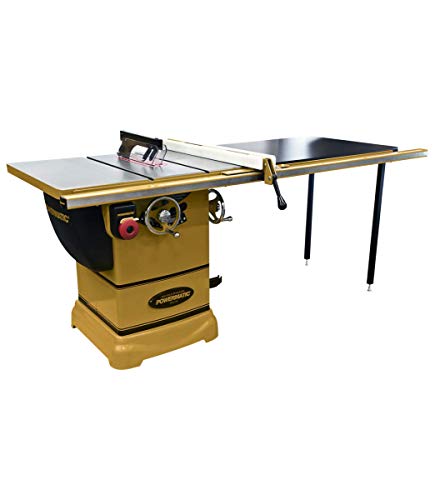
Powermatic 10-Inch Table Saw (PM1000)
Powermatic’s PM1000 earns its editor’s choice status for one simple reason: it’s built for serious work. You’ve probably outgrown undersized saws that wobble, drift, and frustrate you mid-cut. Here’s the thing — the PM1000 fixes all of that. Its 52-inch rip capacity handles sheet goods without compromise, while the precision-ground cast-iron surface keeps everything flat and stable. The Accu-Fence system locks rigid every time, so you’re not second-guessing alignment. Seven handwheels give you intuitive control, and the Poly-V belt keeps vibration laughably low. If you want professional results without the industrial price tag, this one’s obviously yours.
- Motor Power:1-3/4 HP
- Voltage:115/230 V single-phase
- Blade Size:10 in
- Blade Teeth:50 teeth
- Motor Speed:4200 RPM
- Warranty:5-year limited warranty
- Additional Feature:52 in. rip capacity
- Additional Feature:7-handwheel ergonomic system
- Additional Feature:Toolless guard assembly
SawStop Professional Cabinet Saw 1.75HP (PCS175-TGP236)
Safety-conscious woodworkers starting out get a genuine lifeline with the SawStop PCS175-TGP236. Here’s the thing — you already know table saws are dangerous. SawStop’s blade-stop technology detects skin contact and kills the blade instantly, and that’s not marketing fluff. It’s real, tested, and genuinely reassuring. The 1.75HP motor handles serious ripping at 110V, so no special wiring headaches. You’re also getting a 36-inch T-Glide fence that’s smooth, accurate, and frustration-free. Obviously it’s pricier than basic saws, but if safety keeps you hesitating in the shop, this one removes that hesitation permanently. That’s worth deciding on.
- Motor Power:1.75 HP
- Voltage:110 V
- Blade Size:10 in
- Blade Teeth:40 teeth
- Motor Speed:4000 RPM
- Warranty:Limited warranty
- Additional Feature:Skin-contact blade stop
- Additional Feature:36″ T-Glide fence
- Additional Feature:110V single-phase power
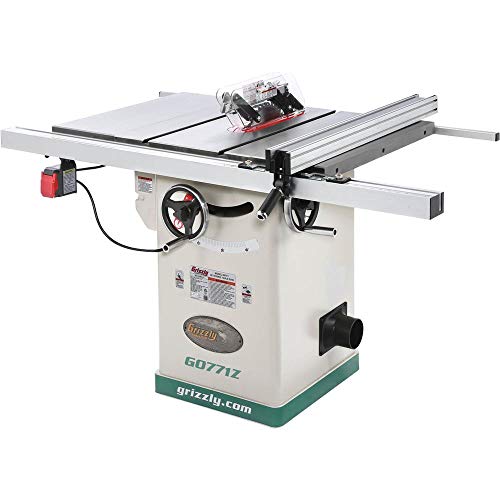
Grizzly Industrial 10″ Hybrid Table Saw (G0771Z)
If your wallet’s wincing but your workshop ambitions aren’t, the G0771Z is your sweet spot. Here’s the thing — hybrid saws often get dismissed as compromise machines, but Grizzly earns its reputation honestly. You’re getting a 2 HP, 15-amp motor spinning at 3450 RPM on 120V, meaning no special wiring headaches. The 50-tooth HSS blade and T-shaped fence are genuinely solid starting points. Obviously, it won’t out-muscle a full cabinet saw. But if you’re cutting on a serious home-shop budget, the cast-iron surface and ETL certification tell you Grizzly isn’t cutting corners where it counts. Buy it confidently.
- Motor Power:2 HP
- Voltage:120 V
- Blade Size:10 in (implied by 50-tooth HSS spec)
- Blade Teeth:50 teeth
- Motor Speed:3450 RPM
- Warranty:Limited warranty
- Additional Feature:ETL & ISO 9001 certified
- Additional Feature:Cast-iron work surface
- Additional Feature:Depth adjustment feature
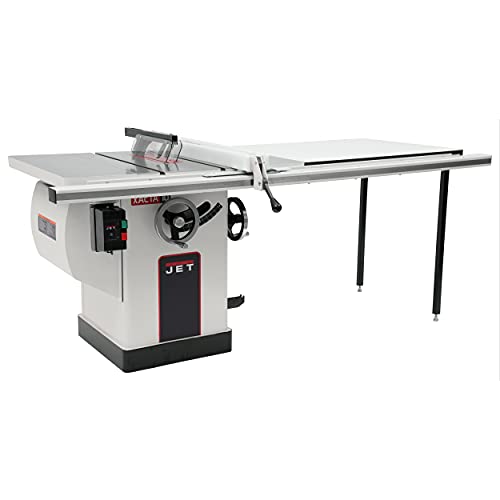
JET 10-Inch XACTA Table Saw (JTAS-10XL50-1DX)
Meet the JET JTAS-10XL50-1DX — professional-grade precision built for woodworkers who refuse to babysit their equipment. You’ve probably wasted time fighting a fence that drifts or a blade that creeps mid-bevel. JET fixes that. The 50-inch XACTA Fence II locks down hard with a powdered-metal lock, and the left-tilting blade handles bevel cuts without burning your stock. Here’s the thing — the cast-iron trunnion eliminates vibration while machined worm gears keep adjustments honest. You get a 3 HP motor, poly-V belt drive, and a modular blade guard that actually follows height changes. This one’s built for you.
- Motor Power:3 HP
- Voltage:230 V single-phase
- Blade Size:10 in
- Blade Teeth:Not specified
- Motor Speed:4300 RPM
- Warranty:5-year limited (2-year commercial use)
- Additional Feature:50 in. rip capacity
- Additional Feature:Left-tilting blade
- Additional Feature:5-year warranty
Factors to Consider When Choosing Cabinet Table Saws
Picking the right cabinet table saw feels overwhelming when every spec sheet reads like a foreign language — but here’s the thing, a few key factors cut through the noise fast. You’ll want to match motor power and voltage to your shop’s electrical setup, since a 3HP single-phase motor runs fine in most home workshops while serious production work usually demands a 5HP, 240V setup that’ll push through hardwoods without bogging down. Obviously blade size and speed matter, but so does rip capacity, table size, and whether that table surface is cast iron or something cheaper — because the saw that fits your projects, your space, and your budget is always the right saw.
Motor Power and Voltage
Nothing kills a woodworking session faster than underpowered equipment struggling through a thick slab of white oak like it’s fighting for its life. Here’s the thing — motor power and voltage aren’t just specs on a box. They’re what separates a smooth, confident cut from a burned blade and a tripped breaker.
If you’re running 120V, you’ll likely need a dedicated circuit. Obviously, that’s extra setup. But a 220-240V motor runs at lower amperage, delivering steadier torque without taxing your wiring. For heavy hardwoods, you want at least 3 HP and a continuous-duty motor — one built to run without overheating.
Now, if your workload’s light-to-medium, 1.75 HP handles it fine. Match your voltage, know your amperage, and choosing becomes genuinely simple.
Safety Features Matter
When a spinning blade’s involved, safety features aren’t optional — they’re the whole conversation. You already know someone who’s learned that the hard way. Here’s the thing — modern cabinet saws have genuinely gotten smarter about protecting you.
Automatic blade-stop systems can halt the blade within 5 ms of skin contact. That’s not marketing fluff — that’s the difference between a scratch and a hospital visit. Now, riving knives prevent kickback by stopping the wood from pinching mid-cut, which honestly saves you before you even realize danger happened.
Positive-lock fences keep everything square and binding-free. Dust hoods improve visibility while bevel locks prevent accidental angle shifts.
All right — if you care about your fingers, prioritize these features first. Everything else is secondary.
Blade Size and Speed
Blade size and speed might sound like specs you gloss over, but they’re actually where most buyers quietly get it wrong. Obviously, a bigger blade cuts deeper — a 10-inch blade handles serious material removal that smaller blades simply can’t touch. But here’s the thing: speed matters just as much. Cabinet saws typically run between 3,000 and 4,300 RPM, and that range isn’t arbitrary. Push a larger blade at higher RPM without the right carbide-tipped teeth, and you’re generating heat that destroys both your blade and your workpiece. Now, tooth count shapes your outcome too — 40 to 50 teeth on a 10-inch blade balances smooth finishes with efficient cutting. Match your blade to your saw’s speed, and you’ll wonder why you ever second-guessed this purchase.
Rip Capacity Range
Rip capacity is the measurement that quietly determines whether your cabinet saw becomes your best friend or your biggest frustration. You’ve probably wrestled a wide board halfway through a cut only to run out of fence. That’s a rip capacity problem, and it’s fixable before you buy.
Here’s the thing — a 36-inch capacity handles your standard 2×4s and 2×6s without complaint. But if you’re cutting sheet goods or wide panels regularly, you’ll want 48 inches or more. Obviously, bigger capacity means a heavier table and beefier fence system.
Now, some saws offset a shorter base capacity with fence extensions or sliding tables, which genuinely helps. Know your typical board sizes first, then match the saw to your actual work — not your wishful thinking.
Table Size and Material
Table size is the silent deal-breaker that most buyers ignore until they’re fighting a full sheet of plywood with nowhere to rest it. Obviously, bigger is better — but here’s the thing: material matters just as much as dimensions. A 27×75-inch cast-iron table isn’t just large; it’s *stable*. Cast iron dampens vibration, kills drag, and keeps your blade accurate under heavy load in ways aluminum or thin steel simply won’t. You’ll feel the difference immediately on delicate cuts where tear-out ruins everything. Now, if your shop runs tight, don’t panic — modular extension tables let you expand without rebuilding your whole setup. Pick cast iron with ribbed reinforcement, and you’ve fundamentally solved three problems at once. That’s a smart buy.
Weight and Dimensions
Weight isn’t just a spec on a page — it’s the difference between a saw that stays put under load and one that creeps, vibrates, and slowly drives you insane mid-cut. Here’s the thing: heavier, fully enclosed cabinets genuinely outperform lighter open-stand designs because the mass absorbs vibration before it reaches your workpiece. Obviously, that comes with trade-offs — a 350 lb+ full-size cabinet needs real floor space, somewhere between 85 × 43 × 44 inches on the generous end. Compact hybrids under 300 lb fit tighter shops but sacrifice some stability. Work surface height typically lands around 34 inches, which suits most people just fine. Know your shop’s square footage before committing, and suddenly the right size becomes obvious.
Warranty and Support
Once you’ve sorted out how much floor space your new saw’s going to swallow, there’s one more thing standing between you and a confident purchase — and most buyers completely overlook it until something goes wrong. Warranty coverage varies wildly. You’re typically looking at one to five years, but here’s the thing — confirm it covers both the motor *and* the safety system, because some plans quietly skip the latter. Now, check whether repairs happen on-site or require you to ship a 600-pound machine somewhere. Obviously, nobody wants that headache. Find out if there’s a clear claims process with documented steps and authorized service centers. All right, one last thing — a transferable warranty genuinely boosts resale value, so don’t ignore it.