If your table saw struggles through hardwood or leaves burn marks on oak, the blade is the problem. You need a rip-specific workhorse with aggressive tooth geometry and a thin kerf. We’ve broken down seven pro-grade options that deliver straight, glue-ready edges. Which one matches your shop? Let’s find out.


More Details on Our Top Picks
FOXBC 10-Inch Flat Tooth Ripping Saw Blade
If you’re ripping plywood and laminates all day, a thin kerf blade saves you material and motor strain. FOXBC’s 10-inch flat tooth ripping blade does exactly that. It’s a 24-tooth beast with a .094-inch kerf and a 5/8-inch arbor. This thing cuts hard and softwood, chipboard, and laminates from 3/4 to 2-3/4 inches thick. High-density tungsten carbide keeps it durable, while the 20° hook angle gives you fast, smooth cuts with less vibration. You get strong results for ripping and crosscutting. It’s compatible with DeWalt, Makita, and more. A solid choice for quick, precise work.
- Blade Diameter:10 inches
- Arbor Size:5/8 inch
- Tooth Count:24
- Kerf Thickness:0.094 inches
- Material:Tungsten carbide
- Tooth Design:Flat tooth
- Additional Feature:Thin kerf design (.094″)
- Additional Feature:20° hook angle
- Additional Feature:High-density tungsten carbide
Freud Heavy-Duty Rip Saw Blade – 10″ Diameter 24 Teeth 5/8″ Arbor
Freud’s Heavy Duty Rip Saw Blade is your go to choice if you need a heavy duty champion for consistent, large volume ripping. It sports 24 flat top teeth with TiCo carbide, staying sharper longer. The Perma-SHIELD coating fights heat and pitch, so you’re not fighting the blade. And those laser cut anti-vibration slots? They kill chatter cold.
Here’s what it does best:
- Rips hardwoods and softwoods from 3/4 to 2-3/4 inches thick, fast and clean.
- Leaves a splinter free edge ready for glue ups.
- Handles gang ripping and plywood crosscuts, though thinner stock may dull the finish slightly.
With a 5/8 inch arbor and .126 kerf, it’s built for industrial tasks. Freud backs it with a limited lifetime warranty. You’re getting a serious workhorse.
- Blade Diameter:10 inches
- Arbor Size:5/8 inch
- Tooth Count:24
- Kerf Thickness:0.126 inches
- Material:TiCo high-density carbide
- Tooth Design:Flat top carbide teeth
- Additional Feature:Perma-SHIELD non-stick coating
- Additional Feature:Laser-cut anti-vibration slots
- Additional Feature:TiCo high-density carbide tips
Freud LM72M010: 10″ Heavy-Duty Rip Blade
You want an industrial grade rip blade without the industrial price tag. Freud’s LM72M010 delivers. Its 24 flat top teeth, with a steep 20° hook angle, aggressively rip through hardwoods and softwoods from 3/4 to 2 3/4 inches thick. The TiCo Hi-Density Carbide tips resist heat and impact, while the Silver I.C.E. coating prevents resin buildup. Anti vibration slots reduce chatter so you get glue line ready cuts. Plus, you can resharpen those large teeth multiple times, saving you money. It’s a precision balanced, laser cut workhorse.
- Blade Diameter:10 inches
- Arbor Size:5/8 inch
- Tooth Count:24
- Kerf Thickness:0.126 inches
- Material:TiCo Hi-Density Carbide
- Tooth Design:Flat-top tooth
- Additional Feature:Silver I.C.E. coating
- Additional Feature:Precision-balanced and pretensioned
- Additional Feature:TiCo Hi-Density Carbide tips
10-Inch 24T Carbide Table Saw Blade with 5/8-Inch Arbor for Ripping
This budget-friendly pick gives you a HARDWIN 10-inch 24 tooth carbide blade perfect for getting clean rip cuts without the high price tag. Its 24 teeth make efficient work of hardwood, softwood, plywood, and composites. You’ll appreciate the thin kerf (0.094 inches) that reduces resistance and noise, while the plate (0.071 inches) cuts down on vibration and waste. It runs smoothly at 6800 RPM, so you get stable, high speed ripping. And with a 5/8 inch arbor, it fits your Makita, Milwaukee, or Skil saw. Plus, you get 24/7 after sales support for peace of mind.
- Blade Diameter:10 inches
- Arbor Size:5/8 inch
- Tooth Count:24
- Kerf Thickness:0.094 inches
- Material:Tungsten carbide
- Tooth Design:24 teeth (carbide)
- Additional Feature:Operates at 6800 RPM
- Additional Feature:Brazing technology construction
- Additional Feature:Thin kerf (0.094″)
DEWALT 10 in. 24 Tooth Carbide Saw Blade (DWA11024)
The DEWALT 10 in. 24 Tooth Carbide Saw Blade (DWA11024) is our most popular choice for a reason. You get a blade that lasts up to three times longer than standard options, thanks to ultra-sharp carbide tips. Its optimized tooth geometry delivers clean cuts across hardwood, softwood, trim, plywood, and OSB. Weighing just 12.8 ounces, it’s lightweight but tough. And with a stellar 4.8 star rating from over 1,400 reviews, it’s a clear winner. For general ripping tasks, this blade combines precision and durability you can rely on.
- Lifespan: Up to 3x longer than standard blades
- Materials: Hardwood, softwood, plywood, OSB, trim
- Rating: 4.8 out of 5 stars
- Blade Diameter:10 inches
- Arbor Size:5/8 inch
- Tooth Count:24
- Kerf Thickness:Not specified
- Material:Carbide-tipped
- Tooth Design:Ultra-sharp carbide-tipped teeth
- Additional Feature:Up to 3x longer lifespan
- Additional Feature:Optimized tooth geometry
- Additional Feature:Ultra-sharp carbide-tipped teeth
CMT Orange Tools 10″ Ripping Saw Blade 24T
Built for serious ripping, the CMT Orange Tools 10″ Ripping Saw Blade 24T hits a professional standard right out of the box. You’re getting a 10-inch diameter with a 5/8-inch arbor, perfect for your table saw or chop miter. Those 24 flat-top teeth mean fast, aggressive cuts through stock, and a 0.126-inch kerf keeps things balanced. It’s a favorite among furniture and CNC pros—and the 4.8-star rating from 147 users backs that up. Grab it for reliable ripping without the guesswork. And remember, CMT backs it with a 30-day return guarantee if it’s not your fit.
- Blade Diameter:10 inches
- Arbor Size:5/8 inch
- Tooth Count:24
- Kerf Thickness:0.126 inches
- Material:Carbide
- Tooth Design:Flat-top teeth
- Additional Feature:Compatible with chop miter saw
- Additional Feature:Industrial CNC application suitable
- Additional Feature:0.126″ blade thickness
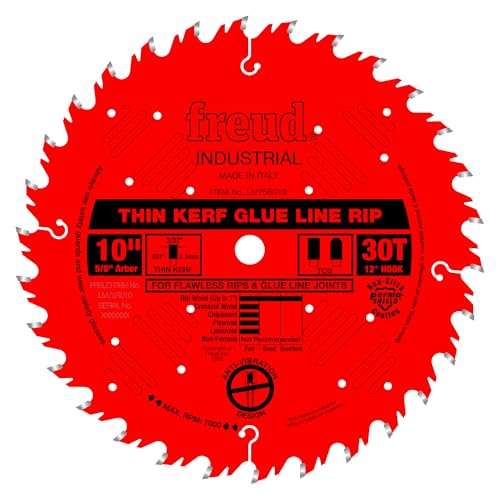
Freud LM75R010: 10″ Industrial Thin Kerf Glue Line Ripping Blade Carbide
Need to rip stock for a glue up without jointing first? Freud’s LM75R010 blade makes that a reality. You get a 30-tooth, thin kerf design with a triple chip grind that delivers glue-line ready surfaces straight off the saw. No jointing, minimal sanding. That saves you serious time.
The TiCo Hi-Density carbide teeth stay sharp, while laser-cut anti-vibration slots kill chatter. You’ll cut clean, true, and stable. A Perma-Shield coating fights pitch buildup and corrosion, so maintenance is a breeze. Use it on stock from 1/8 to 1 inch thick. It’s a pro move for seamless glue ups.
- Blade Diameter:10 inches
- Arbor Size:5/8 inch
- Tooth Count:30
- Kerf Thickness:0.091 inches
- Material:TiCo Hi-Density Carbide
- Tooth Design:Triple chip tooth
- Additional Feature:Triple chip tooth design
- Additional Feature:Perma-Shield non-stick coating
- Additional Feature:12° hook angle
Factors to Consider When Choosing a Table Saw Rip Blade
Before you commit to a blade, you’ve got five key specs to weigh: tooth count, kerf width, arbor size, hook angle, and carbide grade. Each one changes how the blade behaves on your saw, and getting them wrong means poor cuts or even a dangerous setup. Think of these as the personality traits of your blade, so let’s walk through what they actually mean for your ripping work.
Tooth Count
Two numbers dominate the spec sheet when you’re picking a rip blade: the tooth count and the hook angle. For ripping, fewer teeth means faster cuts. A 24 tooth blade aggressively chews through thick stock, maximizing material removal. You’ll get a rougher edge, but that’s fine for joinery. Want a smoother finish for crosscuts? Then reach for a 40 tooth blade or more. It creates cleaner surfaces with less tear out, though it cuts slower. More teeth also reduce chatter and splintering. So ask yourself: what’s the priority? Speed for ripping, or finish for final pieces? Match your tooth count to the task. It’s that simple.
Kerf Width
So how thick is that cut going to be? That’s kerf width, and it directly affects your material waste and cutting effort. A thinner kerf, around 0.094 inches, removes less wood. That means less waste, lighter cuts, and it’s a dream for your saw’s motor, especially if you’re pushing an underpowered model. But don’t expect it to handle heavy abuse.
A thicker kerf, like 0.126 inches, gives you a more stable, durable blade. It’s tougher, but it sacrifices more material to the dust bin. For expensive or limited stock, go narrow to conserve every inch. Match your choice to your project’s precision needs and your saw’s power. If your saw struggles, a thin kerf keeps you cutting smoothly without bogging down.
Arbor Size
One number you absolutely cannot overlook is the arbor size, which is the diameter of the shaft on your saw that the blade mounts onto. Your saw’s arbor and the blade’s bore must match perfectly for safe, vibration-free operation. For most consumer table saws, that’s a standard 5/8-inch arbor. But you might encounter 1-inch or 1-1/4-inch arbors on larger, industrial models.
Don’t assume compatibility. A blade with a bore that’s too small won’t fit at all, while one that’s too large will wobble dangerously. That’s a recipe for ruined cuts and serious safety hazards.
Before you buy, grab your manual or measure your arbor. Look for blades explicitly designed with a 5/8-inch bore, as that’s your most reliable fit. Verify that match precisely, and you’ll avoid improper fitment completely. Your saw will thank you.
Hook Angle
What exactly does hook angle mean for your rip cuts, and why should you care? Simply put, it’s the tilt of the tooth that determines how aggressively the blade bites into the wood. For rip blades, you’ll typically see hook angles between 10° and 20°.
A higher hook angle, say 20°, gives you a more aggressive cut. You’ll rip through stock faster, but you’ll also feel more resistance. That’s your trade off: speed for control. Conversely, a lower hook angle, around 10°, means a less aggressive, smoother finish. It’s gentler on the material and your arms.
Here’s the quick breakdown:
- For speed: choose a 15° to 20° hook angle.
- For smoothness: stick with a 10° to 15° angle.
Match the angle to your material and desired cut quality. Want fast rips on construction lumber? Go higher. Need a clean edge on hardwoods? Go lower. It’s that simple.
Carbide Grade
Carbide grade is one of those details that quietly makes or breaks your rip blade’s performance. You want a higher grade, like TiCo or micrograin carbide, for serious longevity. Finer grain sizes deliver a sharper edge that stays keen longer, while tougher grades handle scorching temperatures without chipping.
Here’s the quick benefit: premium carbide resists wear far better, meaning you’ll get more sharpening cycles out of it before replacement. That saves you money over time. The chemical makeup also fights corrosion, keeping the edge pristine. So when you’re picking a blade, don’t just look at tooth count. Check what carbide is actually on those tips. It’s a small detail with a massive impact on cut quality and blade life.
Anti-Vibration Features
Since vibrations create micro movements that throw your cut off course, anti-vibration features are where blade makers prove their engineering chops. You’ll notice laser cut slots or pretensioned bodies in top blades: these reduce resonance and chatter, letting you rip with surgical precision. Less lateral movement means cleaner cuts and fewer splinters on your workpieces.
Plus, you get a quieter shop. That noise reduction isn’t just comfort; it’s a safety upgrade, helping you stay focused. And your blade lasts longer, too, because you’re dropping mechanical stress on both the steel and your saw arbor.
Here’s what to look for:
- Laser cut slots to dampen vibration
- Pretensioned steel to maintain flatness
- Thin kerf designs that cut resistance
Each feature fights micro wobble, so your rip cuts stay true, smooth, and splinter free. No gimmicks, just engineering that keeps you in control.
Material Thickness Range
First, let’s talk thickness range. You’ll want a rip blade that handles everything from 3/4 inch plywood up to a beefy 2-3/4 inch hardwood slab. That sweet spot covers most pro jobs, so don’t settle for less. Pair that with a kerf width matching your material; thinner stock means you can go thin kerf to save waste, but thicker boards demand a full kerf for stability.
Now, check the gullets. Larger tooth gullets are your best friend for thick cuts because they clear sawdust fast and stop binding. Grab a blade engineered for that exact range you rip most often. If you’re always slicing 8/4 oak, don’t buy a sheet-good specialist. Match the blade to your daily reality, and you’ll get smooth, accurate cuts every time without wrestling the saw.