You know the frustration of a wandering blade, that jagged edge ruining a perfectly good piece of plywood. A quality guide rail is your fix, turning a jigsaw into a precision tool for straight, clean cuts every time. We’ve rounded up five top contenders, from lightweight portable models to heavy duty workhorses.
| Ryobi OEM 202936001 Jigsaw Edge Guide Assembly P523 P5231 |  | Best for Ryobi | Compatibility: Ryobi P523 jig saws only (OEM part) | Material: Plastic handle; high-speed steel blade | Weight: 3.04 ounces | VIEW LATEST PRICE | Read Our Analysis |
| Makita 194368-5 55″ Guide Rail |  | Professional Grade | Compatibility: Makita plunge saws XPS01, XPS02, SP6000J; routers/circular saws with adapters | Material: Aluminum body; high-speed steel blade | Weight: 6.7 pounds | VIEW LATEST PRICE | Read Our Analysis |
| Swanson 100″ Cutting Guide Aluminum Straight Edge Saw/Fence Guide CG100 |  | Best for Large Panels | Compatibility: Circular saws, sabre saws, routers, utility knives | Material: High-grade anodized aluminum | Weight: 3.2 pounds | VIEW LATEST PRICE | Read Our Analysis |
| Milescraft 1403 Universal Saw Guide |  | Budget-Friendly Pick | Compatibility: Most circular and jig saws (right/left-handed) | Material: Plastic/composite/metal; high-speed steel blade | Weight: 16 ounces | VIEW LATEST PRICE | Read Our Analysis |
| Bora Jigsaw Guide for Clamp Edge |  | Best for Jigsaws | Compatibility: Most jigsaws; Bora WTX and NGX Clamp Edge systems | Material: Plastic/rubber handle; high-speed steel blade | Weight: 0.27 grams | VIEW LATEST PRICE | Read Our Analysis |
More Details on Our Top Picks
Ryobi OEM 202936001 Jigsaw Edge Guide Assembly P523 P5231
If you own a Ryobi P523 jig saw, this edge guide is your perfect match. It’s a genuine OEM replacement part, model 202936001, designed specifically for your tool. You’ll get straight, clean cuts in wood without wandering off your line. The guide itself is lightweight at just 3.04 ounces, so it won’t weigh you down. Its plastic handle feels sturdy enough for repetitive work. Installation is simple, but always check your owner’s manual first to guarantee proper fit. With an 18-volt motor running at 4,500 rpm and an 8-tooth blade, you’re set for precision. Amazon offers a 30-day return window if needed.
- Compatibility:Ryobi P523 jig saws only (OEM part)
- Material:Plastic handle; high-speed steel blade
- Weight:3.04 ounces
- Cut Capabilities:Edge guiding for straight cuts
- Dimensions:4.13″ L × 4.13″ W × 10.5″ H
- Power Source:Manual
- Additional Feature:Genuine OEM replacement part
- Additional Feature:Bulk packed (no retail box)
- Additional Feature:Consult owner’s manual for installation
Makita 194368-5 55″ Guide Rail
The Makita 194368-5 55” Guide Rail is the professional grade backbone of precision cutting. You’ll pair it with your Makita plunge saw like XPS01 or SP6000J for dead on straight or bevel cuts. But don’t stop there. Use the router guide rail adapter 194579-2 or saw adapter 196953-0 to make it work with select routers and circular saws. It’s 55.11 inches long, but only 6.7 pounds, so you won’t dread hauling it out. The aluminum build guarantees smooth, accurate cuts every time. You get a one year warranty, and with a 4.7 star rating from 4,880 reviews, it’s a trusted choice.
- Compatibility:Makita plunge saws XPS01, XPS02, SP6000J; routers/circular saws with adapters
- Material:Aluminum body; high-speed steel blade
- Weight:6.7 pounds
- Cut Capabilities:Straight and bevel cuts
- Dimensions:55.11″ L × 7.28″ W × 0.43″ Thick
- Power Source:Battery-powered (included)
- Additional Feature:Works with circular saws (with adapter)
- Additional Feature:55.11-inch aluminum rail
- Additional Feature:Compatible with select routers
Swanson 100″ Cutting Guide Aluminum Straight Edge Saw/Fence Guide CG100
You’re working with full sheets of plywood or MDF and need a guide rail that can handle the span without compromise. The Swanson 100″ Cutting Guide delivers. It comes as two 50 inch aluminum straightedges that join together using a included joiner bar, giving you a full 100 inches of guiding surface. That’s enough for 4×8 foot sheets, no problem. High grade anodized aluminum keeps it durable and rust resistant. You get C clamps and thumb screws to lock it securely to your work surface. It’s lightweight at just 3.2 pounds, easy to break down for storage, and works with circular saws, routers, sabre saws, and utility knives. Plus it carries a 1 year warranty.
- Compatibility:Circular saws, sabre saws, routers, utility knives
- Material:High-grade anodized aluminum
- Weight:3.2 pounds
- Cut Capabilities:Straight cuts up to 100 inches (expandable)
- Dimensions:Two 50″ sections, expandable to 100″
- Power Source:Manual (tool-powered)
- Additional Feature:Expandable to 100 inches
- Additional Feature:Break-down design for storage
- Additional Feature:Includes C-clamps and thumb screws
Milescraft 1403 Universal Saw Guide
For hobbyists and DIYers chasing workshop-grade accuracy on a tight budget, the Milescraft 1403 Universal Saw Guide is your budget-friendly pick to tame unruly circular and jig saws into precision cutting tools. You’ll get straight cuts up to 14 inches, circles up to 24 inches with your jigsaw, and it handles angles and bevels too. Its universal base plate fits most saws, and the reversible edge guide keeps you cutting without setup hassles. Weighing just 16 ounces, it’s lightweight but sturdy. Plus, it works for both righties and lefties. That’s serious versatility without breaking the bank!
- Compatibility:Most circular and jig saws (right/left-handed)
- Material:Plastic/composite/metal; high-speed steel blade
- Weight:16 ounces
- Cut Capabilities:Straight cuts up to 14 inches; circles up to 24 inches diameter; angles and bevels
- Dimensions:12″ L × 6″ W × 1″ H
- Power Source:Hand-powered
- Additional Feature:Cuts circles up to 24 inches
- Additional Feature:Reversible edge guide feature
- Additional Feature:Supports right and left-handed saws
Bora Jigsaw Guide for Clamp Edge
Own a jigsaw but struggle with wobbly, uneven cuts? The Bora Jigsaw Guide (model 542009) locks your saw into their Clamp Edge system, and it’s a game changer. You get two tongue-and-groove points that slide smoothly on the T-track, so drifting and twisting become history. An adjustable sliding side and locking screw fit most jigsaws, while the pointer guide keeps cuts true.
You can handle:
- Straight rip cuts and 45-degree bevels.
- Full 360-degree circular cuts.
The built-in screw clamp holds your jigsaw tight, reducing binding. At just 0.27 grams, it’s lightweight but tough. Backed by a 4.1-star rating, this guide delivers precision without the wobble.
- Compatibility:Most jigsaws; Bora WTX and NGX Clamp Edge systems
- Material:Plastic/rubber handle; high-speed steel blade
- Weight:0.27 grams
- Cut Capabilities:Straight cuts, 45-degree cuts, circular cuts up to 360 degrees
- Dimensions:8.5″ L × 5.5″ W × 2″ H
- Power Source:Manual (tool-powered)
- Additional Feature:Works with WTX/NGX Clamp Edge
- Additional Feature:Tongue-and-groove design
- Additional Feature:Adjustable sliding side and locking screw
Factors to Consider When Choosing Jigsaw Guide Rail
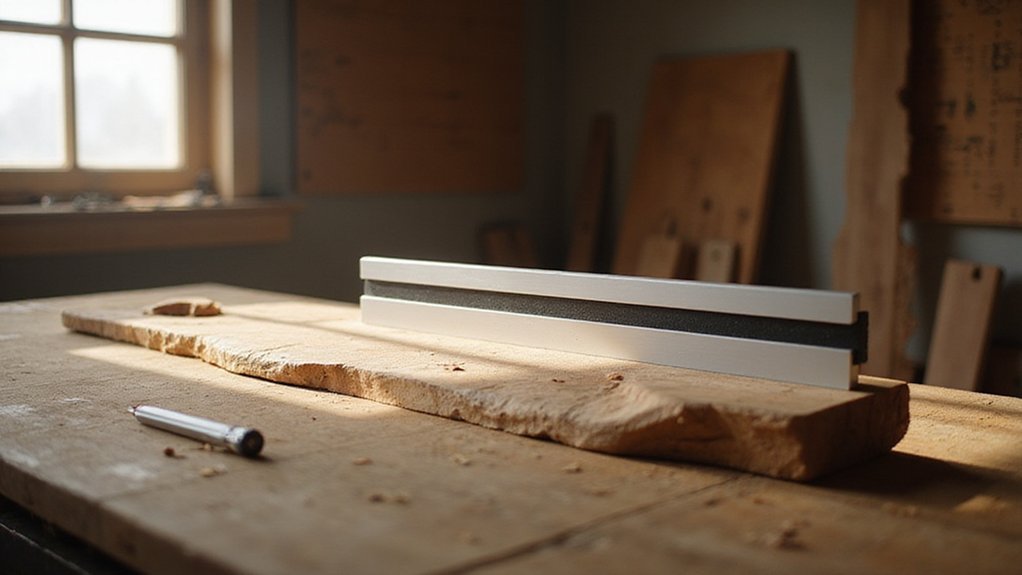
You need to match the guide rail to your jigsaw’s blade type for a clean, accurate cut, since a mismatched setup just leads to tearout and frustration. Also, check the rail’s material and cutting length capacity; a lightweight aluminum rail is portable for small jobs, but a steel one with a 48-inch track handles full sheet cuts far better. And don’t forget how the saw attaches to the rail, because a clamp-on system offers quick swaps, while a track saw style adapter gives you more precision for repeated cuts.
Material Compatibility
Why does material compatibility matter so much when choosing a jigsaw guide rail? Because the rail’s own construction dictates how well it handles the materials you’ll cut. You need a rail made from sturdy, wear-resistant aluminum or high-grade steel; those handle frequent use on wood, metal, or plastic without flexing, keeping your cuts accurate.
Check that the rail’s mounting and clamping systems match your jigsaw model specifically. A secure attachment prevents wobble, which ruins precision. Also, confirm the rail is designed for your saw’s base plate size. And look for a surface that allows easy adjustments and clean handling. You’ll appreciate a rail that doesn’t bind or scratch your workpiece, especially on softer materials like pine. Pick a rail that matches your work habits, and you’ll cut confidently every time.
Blade Type Matching
Because the blade you choose directly determines how cleanly your jigsaw cuts through material, matching that blade to your guide rail is just as critical as the rail’s own construction. You can’t just slap any rail on and hope for the best. First, verify the rail supports your blade’s thickness and width; a flimsy fit invites wobble. Then, check that its built-in features align with your blade’s teeth per inch (TPI), since a high-TPI blade demands a tighter, more precise channel. Also, confirm the rail accommodates your blade’s length, so it guides you through the entire cut without stalling. Finally, ascertain the mounting mechanism locks securely, preventing binding. Match these specs, and you’ll get straight, chatter-free results every time.
Cutting Length Capacity
One key factor to nail down is the cutting length capacity, which simply means the maximum length of cut your guide rail can support. This directly impacts the size of materials you can work with. For big projects, a longer rail, say 100 inches, lets you slice through large sheets without repositioning. That’s a real time saver! So, match the rail’s length to your typical project dimensions. Doing so avoids the hassle of extensions or frustrating limitations. A higher capacity gives you more versatility, whether you’re cutting plywood or plastic. But here’s a heads up: longer rails often need extra support or clamps to stay straight over extended lengths. Otherwise, you might end up with wobbly cuts. Keep that in mind, and you’ll pick a rail that fits your workflow perfectly.
Guide Rail Material
When you’re choosing a jigsaw guide rail, the material it’s made from is a major player in performance and longevity. High-grade aluminum is your best bet for durability. It resists wear beautifully, keeping your cuts straight rail after rail. Lightweight aluminum also saves your arm during long sessions, a real plus if you’re doing a big job.
You’ll want a corrosion-resistant option, too. Anodized aluminum holds up against moisture and shop dust, so your rail stays true over time. Rigidity matters as well: a stiffer material prevents flex, giving you precise, clean lines every time. And compatibility? Metal rails often pair better with jigsaw clamps, making setup a breeze. Stick with aluminum for a balance of strength, lightness, and lasting performance.
Saw Attachment Method
Since the saw attachment method directly determines how steady your cut will be, it’s worth paying close attention to. You’ll find two common setups: clamp systems and tongue-and-groove joints. Clamps offer quick swaps but can loosen over time, while tongue-and-groove provides a more secure, vibration-free fit. Your saw’s compatibility hinges on this mechanism, so check if it works with your jigsaw specifically. A reliable attachment minimizes wobble, giving you straight cuts every time. For efficiency, look for a system that attaches and detaches without fuss. You don’t want to fight with hardware mid project, right? A snug fit that’s easy to release keeps your workflow smooth. Just guarantee it’s durable enough for repeated use, because that stability pays off in precision.
Portability and Storage
Why drag around a bulky rail that fights you before you even make a cut? Portability starts with a lightweight, compact design. A break-down or foldable rail stashes easily in a cramped toolbox or workshop corner. Look for modular or extendable systems that disassemble into smaller, manageable parts for even more storage flexibility. Carrying handles, cases, or bags make transport a breeze, so you’re not wrestling with an awkward length on every job. Granted, longer rails handle bigger projects, but lightweight materials can offset the heft. And don’t overlook storage footprint: a rail that folds or breaks down lets you maximize limited space. Prioritize these features, and you’ll grab your guide rail without a second thought, ready to cut.
Precision Alignment Features
Precision alignment features are where a guide rail either earns its keep or just takes up space. You need a rail that locks down tight, no shifting mid cut, so check for robust clamps or locking mechanisms. Built in measurement scales or reference markers help you track that cut line perfectly. And if you’re tackling angled cuts, look for compatibility with adjustable bevel settings. Smooth, precise sliding edges minimize deviation, keeping your cuts straight. You don’t want a rail that wobbles or drifts. These features guarantee your jigsaw follows the line, not its own path. A good guide rail gives you confidence; a bad one wastes material. Don’t settle for anything less than rock solid alignment.
Price and Warranty
After locking in a rock solid rail with all the precision features you need, the final hurdle comes down to your budget and the safety net behind the purchase. You’ll want to weigh the price against the rail’s durability and brand reputation to guarantee real value. A longer warranty often signals higher quality and manufacturer confidence. Look for coverage that handles defects in materials or workmanship, and understand the claim process before you buy.
Cheaper guide rails might tempt you, but they often carry limited warranties. That could mean extra costs if something goes wrong. Evaluate the warranty’s duration and coverage to see if it truly protects your investment. Remember, a few extra bucks now can save you headaches later. So, choose a rail that fits your wallet *and* offers a solid safety net you can rely on.