You’re likely reading this because your current saw just can’t keep up with your cut list. That’s frustrating, especially when you’re racing a deadline or a framing job. These eight cordless compound miter saws are built to change that, and we’ll break down exactly which specs matter most.
DEWALT 20V MAX 7-1/4-Inch Miter Saw, Tool Only, Cordless (DCS361B)
https://m.media-amazon.com/images/I/61jWi-6lW7L._AC_SX679_.jpg
This saw is a top pick for pros who need portable power. Weighing just 30 lbs., you’ll easily haul it from truck to jobsite. Its integrated cut line system gives you adjustment free accuracy, so you see exactly where the blade hits.
What you get:
- A cam lock miter handle for quick, precise angle changes.
- A stainless steel detent plate with 11 positive stops.
- Over 183 cuts in 2×4 pine per charge with that 2600 watt motor.
Bevel adjustments are simple via the oversized scale. And you can cut nested crown up to 3 5/8 inches. It’s a compact workhorse that doesn’t compromise on performance.
Factors to Consider When Choosing a Cordless Compound Miter Saw
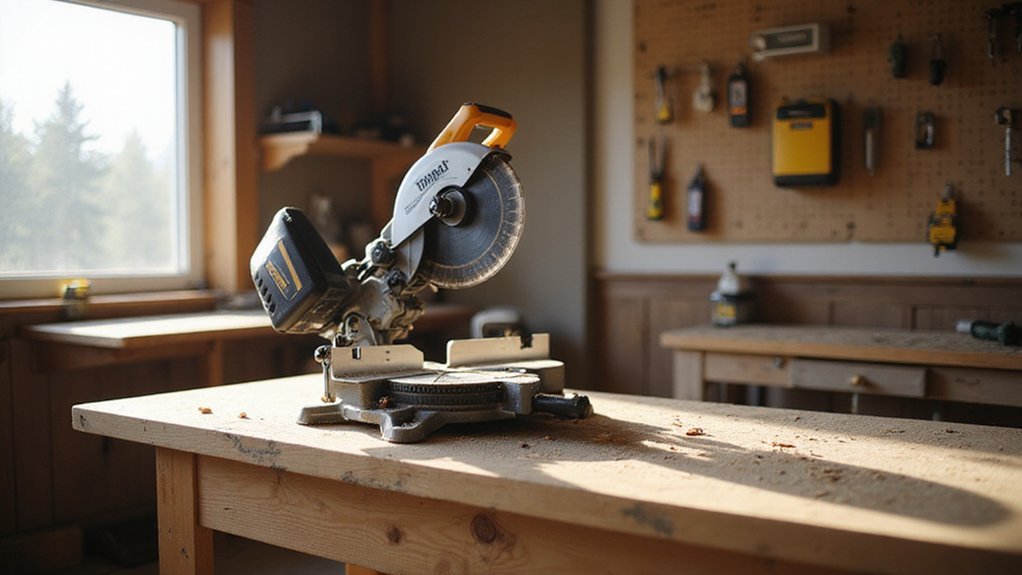
When you’re picking a cordless compound miter saw, you’ve got to weigh five key factors first: power source compatibility, blade size selection, cutting capacity, miter range flexibility, and bevel adjustment options. Your battery platform limits your choices, so stick with what you already own unless you’re ready to invest in a new system. And remember, a 7-1/4-inch blade gives you solid portability, but a 10-inch option delivers deeper cuts for bigger projects.
Power Source Compatibility
What battery platform are you already invested in? Sticking with that brand’s cordless miter saw saves you from buying extra batteries and chargers, which can double your costs. Check the voltage rating, whether it’s 18V, 20V, or 21V, to match your power needs for dense hardwood or long trim runs. Lithium-Ion batteries are indispensable; they deliver longer runtime and charge faster than older nickel-based cells. Also, look at the capacity, measured in mAh or Ah, to ensure it lasts your typical work session without mid-cut interruptions. Finally, decide if you’re buying a bare tool or a kit that includes batteries and a charger. That choice affects both upfront value and long-term compatibility, so weigh it against what you already own.
Blade Size Selection
Why settle for a blade that limits what you can cut? Your blade size directly shapes your saw’s versatility. Common options like 7-1/4 inches and 8 inches handle most woodworking tasks, from detailed trim to framing. But don’t stop there. Larger blades, say 10 or 12 inches, let you tackle wider cuts, though they add weight and cost. Match the size to your material dimensions. Smaller blades excel at precise, delicate work, while bigger ones power through thick or wide stock.
Also check blade compatibility and how easily you can swap them out. A quick change setup saves you headaches mid project. Proper selection locks in superior cutting depth, accuracy, and safety for your specific needs. So pick a blade that fits your cut list, not one that confines it.
Cutting Capacity Range
Since your blade size determines what you can cut, your saw’s cutting capacity range sets the real boundaries. This range tells you the maximum width and height of material the saw can handle, making or breaking your project possibilities. Check the maximum crosscut dimension, like 12 or 14 inches, to know the widest board you can cut across its face. Then look at maximum cut depth, which specifies how thick material can be for beveled or mitered cuts. Sliding models generally give you wider capacity than non-sliding ones, letting you tackle larger boards. And don’t forget to verify capacity at different angles. You’ll need those numbers for complex cuts:
- Maximum width at 0° miter
- Maximum height at 45° bevel
These specifics prevent surprises, ensuring your saw fits your workload.
Miter Range Flexibility
The miter range on your cordless compound miter saw determines just how versatile you’ll be when tackling angled cuts. A wider range, like 0 to 50 degrees, gives you the flexibility to handle everything from basic trim to complex framing. Look for preset miter stops at common angles such as 15°, 22.5°, 30°, and 45°. These let you snap into position fast for repeatable cuts without second guessing.
And don’t overlook dual miter systems that swing both left and right. They’re a game changer for crown molding or multi-angle joints. You’ll want that miter lock to engage securely too, holding your setting steady through repetitive use. A smooth, precise adjustment mechanism across the full range ensures each cut lands accurately every time. That’s the kind of freedom that turns tricky angles into quick wins.
Bevel Adjustment Options
How do you handle bevel cuts without flipping your workpiece? Simple: dual bevel is your answer. This lets the blade tilt both left and right, so you keep your stock in place. Most saws tilt from 0° to at least 45°, but you want a quick release bevel lock and calibrated detents for those repeatable angles. A scaled indicator helps you nail an exact setting fast, without guesswork.
Why does this matter? Because complex projects like crown molding demand swift, accurate adjustments. You’ll switch from a 30° left bevel to a 45° right bevel in seconds, not minutes. Look for smooth pivot action and clear markings. That range and ease directly boost your saw’s versatility, letting you tackle cuts that’d otherwise require flipping the workpiece or a separate tool. No fuss, no wasted time.