If your workshop is tighter than a drum, you already know the struggle of finding room for both a saw and its support. A folding outfeed table is the obvious fix, but most options feel flimsy or cumbersome to set up. The right one, however, transforms your workflow without stealing floor space. Let’s look at three designs that actually deliver on that promise.
| SawStop TSA-FOT Folding Outfeed Table |  | Best Overall | Weight Capacity: 250 lbs | Height Adjustability: Fixed at 34 inches (adjustable feet) | Foldable Design: Yes, folding legs and support tube | VIEW LATEST PRICE | Read Our Analysis |
| Rock-Steady Knock-Down Outfeed Kit with Levelers & Brackets |  | Most Adjustable | Weight Capacity: Not specified (standard outfeed support) | Height Adjustability: 22-5/8 to 37-5/8 inches (steel legs) | Foldable Design: Yes, folding legs | VIEW LATEST PRICE | Read Our Analysis |
| Rockler Rock-Steady Folding Table Saw Outfeed Kit |  | Best Value | Weight Capacity: 150 lbs | Height Adjustability: 1-inch increment telescoping legs | Foldable Design: Yes, hinged steel framework | VIEW LATEST PRICE | Read Our Analysis |
More Details on Our Top Picks
SawStop TSA-FOT Folding Outfeed Table
If you want a seamless extension for your SawStop table saw, this folding outfeed table is your top contender. It’s built from powder-coated steel with an alloy top and roller bars, so your workpiece glides without snagging. The dimensions, 44 by 32 by 34 inches, match your cast iron table and wings perfectly.
Here’s what makes it practical:
- Supports up to 250 pounds, so heavy sheet goods won’t tip it over.
- Folds flat with two support legs and adjustable feet, stashing in under a minute.
- Weighs just 35 pounds, yet stays stable thanks to its stamped steel plates.
You will need a buddy for assembly, but the included hardware and guide make it straightforward. It’s a smart, space-saving investment for your workshop.
And with a 4.2-star rating from 79 users, you’re getting solid performance. Just note the 30-day return window, so inspect it promptly.
- Weight Capacity:250 lbs
- Height Adjustability:Fixed at 34 inches (adjustable feet)
- Foldable Design:Yes, folding legs and support tube
- Material Construction:Powder-coated steel, alloy top, roller bars
- Included Hardware:Roller bars, support plates, assembly guide
- Compatible Saw Type:All SawStop cast iron table saws
- Additional Feature:250 lb weight capacity
- Additional Feature:Roller bars for smooth glide
- Additional Feature:Pre-drilled hardware included
Rock-Steady Knock-Down Outfeed Kit with Levelers & Brackets
You want an outfeed table that won’t wobble on your uneven garage floor. The Rock-Steady Knock-Down Outfeed Kit solves this with adjustable levelers and large paddles for easy fine tuning. Its steel legs range from 22‑5/8 to 37‑5/8 inches, accommodating nearly any setup.
- Quick release hardware lets you attach or remove it in seconds, keeping your shop tidy.
- Folding legs tuck away when not in use.
- Secure brackets and locking pins work with most Biesemeyer style fence saws.
Built from stainless steel or aluminum, it’s durable and stable. You get two leg assemblies, levelers, and brackets right in the box. No wobble, no fuss.
- Weight Capacity:Not specified (standard outfeed support)
- Height Adjustability:22-5/8 to 37-5/8 inches (steel legs)
- Foldable Design:Yes, folding legs
- Material Construction:Stainless steel or aluminum
- Included Hardware:Leg assemblies, levelers, brackets, hardware
- Compatible Saw Type:Biesemeyer-style T-square fence saws
- Additional Feature:Fits Biesemeyer-style fences
- Additional Feature:Height range 22-5/8 to 37-5/8 inches
- Additional Feature:Quick-release attachment hardware
Rockler Rock-Steady Folding Table Saw Outfeed Kit
Rockler’s Rock-Steady kit turns your cabinet saw into a space saving powerhouse with a foldable outfeed table. You’ll build the tabletop from your own materials, so dimensions match your needs perfectly. The steel framework folds down behind the saw for compact storage, and telescoping legs adjust in 1 inch increments with micro adjust hinges and feet for precise leveling. This setup handles loads up to 150 lbs, giving you solid support without the wobble of roller stands. Installation uses slotted brackets and interchangeable bushings to fit saws with tabletop sizes from 30 to 36 inches wide and 40 to 52 inches long. Front and rear crossbars prevent sagging during heavy use. It’s not for contractor saws with motors extending behind, but for cabinet saws, it’s a rock solid space saver!
- Weight Capacity:150 lbs
- Height Adjustability:1-inch increment telescoping legs
- Foldable Design:Yes, hinged steel framework
- Material Construction:Steel framework with hardware
- Included Hardware:Slotted brackets, leg assemblies, crossbars, saw brackets
- Compatible Saw Type:Cabinet saws (30-36″ wide, 40-52″ long)
- Additional Feature:Micro-adjust hinges and feet
- Additional Feature:Telescoping lockable legs
- Additional Feature:150 lb weight capacity
Factors to Consider When Choosing a Folding Table Saw Outfeed Table
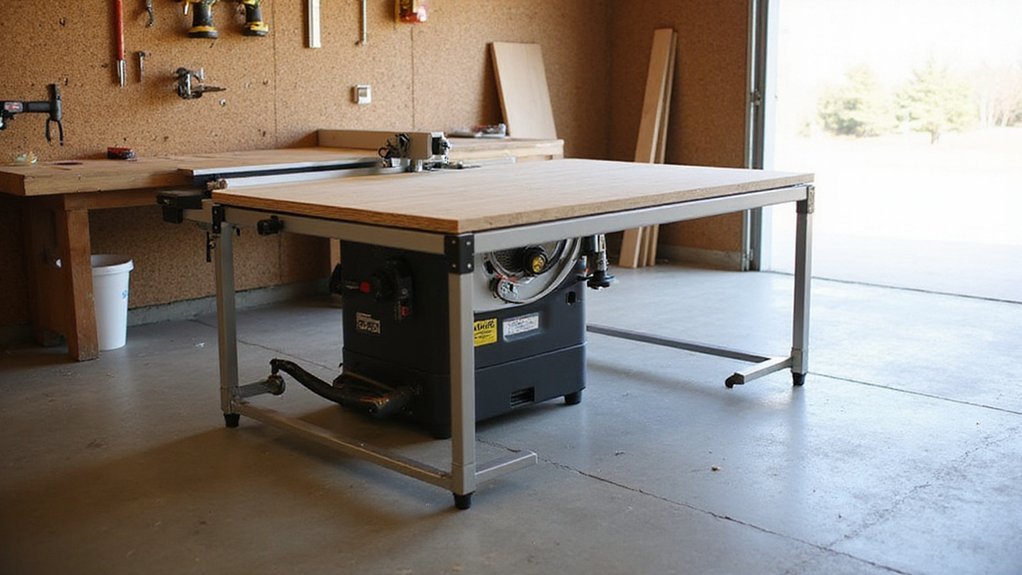
You’ve got a few key factors to weigh before picking your folding table saw outfeed table. Start with weight capacity limits and material durability, since you don’t want a table that buckles under heavy stock or warps after a season. Also check the adjustable height range, workspace and storage size, plus saw compatibility, because a perfect fit makes all the difference in your shop’s workflow.
Weight Capacity Limits
Three key factors determine a folding outfeed table’s weight capacity, and getting this right means the difference between a stable work surface and a dangerous setup. First, you need to exceed your largest workpiece’s load, not just match it. Sagging or structural damage happens fast when you flirt with limits. Second, aim for a minimum of 150 pounds capacity; that covers most heavy panels, cabinets, or glued-up slabs you’ll realistically feed through. Third, check the build materials. Higher capacity tables lean on steel or reinforced alloys, not flimsy stamped aluminum.
Overloading beyond the rated spec compromises stability, and that’s a tip you can’t afford to ignore. Before you buy, scan the manufacturer’s spec sheet and confirm the table matches your typical workload, not just your optimistic weekend project. And remember, a rated limit assumes even weight distribution, so keep heavy loads centered and you’ll stay safe.
Adjustable Height Range
Since your table saw’s height can vary based on the model and your setup, the adjustable height range on a folding outfeed table is what lets you dial in that perfect, ergonomic match. You want a range that handles both your saw’s baseline and your occasional taller workpieces, like that full sheet of plywood. Look for a model reaching up to 37–5/8 inches; that extra clearance is a lifesaver for jigs or thick stock. Lower settings keep you grounded for standard cuts, so you’re not hunching over. And don’t underestimate micro-adjustment knobs, they let you fine-tune alignment without fighting the mechanism. Quick-release levers make mid-project height changes a breeze, so you’re not losing momentum. A wider range simply means you’re ready for whatever the build throws at you.
Material Durability
If you’re hauling your outfeed table from job site to workshop, material durability is where you separate the daily workhorse from the weekend frustration. You want steel that laughs off rust, not stuff that flakes after one damp job. Look for powder-coated or aluminum frames; they resist corrosion and keep their structural integrity through years of abuse. The tabletop thickness matters too. A thin, flimsy surface will flex under a heavy workpiece, but a robust, thick top holds firm without bending or chipping. Don’t overlook the edges either. Chipped or damaged edges weaken the whole unit, so choose high quality construction. And those support brackets? Sturdy ones, paired with adjustable legs, lock everything tight. That combination maintains stability and material integrity, so your outfeed table works hard without letting you down.
Workspace & Storage Size
First up, you’ve got to take a hard look at the actual floor space you’re working with. Grab a tape measure and map out the length and width your outfeed table can occupy when fully extended. You don’t want it sprawling into your walkways or crowding other tools. Then, check where you’ll stash it when not in use. A fold-away design is your best friend in a tight shop, letting you collapse it down and slide it against a wall or under a bench without blocking movement. Don’t forget height adjustments you’ll need to match your saw; measure that too. Prioritize models with compact folded dimensions. This ensures you maintain a comfortable, clutter free workspace while still getting solid support from your outfeed table.
Saw Compatibility
Before you buy, you need to make sure the outfeed table actually plays nice with your specific saw model. Start by checking size, fence system, and mounting points. Does your saw have a Biesemeyer style fence? Look for a table that supports that setup. You also need to verify the table matches your saw’s tabletop thickness and height adjustments. A seamless extension means no awkward gaps. And don’t overlook the hardware. Are the brackets adjustable? For contractor or cabinet models, you’ll want customizable mounting options that fit your saw’s unique configuration. Finally, confirm the outfeed table’s weight capacity handles the materials you typically work with. Heavy boards need solid support. Get this right, and you’ll avoid frustrating mismatches that kill your workflow.
Assembly Complexity
Unless you’re a glutton for punishment, you’ll want to look closely at how much work it takes to get your outfeed table up and running. Some models require tools and special skills, which can turn a quick setup into an afternoon project. Look for kits with detailed instructions and labeled hardware. That’s a lifesaver if you’re not a seasoned builder.
Check the component count. More parts like support legs, brackets, and adjustment mechanisms mean more time and frustration. And modular or foldable designs often need extra steps or tools. That’s a hidden hassle.
Consider if you’ll need a helper. Some tables are heavy or awkward enough that you’ll want a second pair of hands. Before you buy, read the manual. You’ll avoid surprises and get back to cutting sooner.