Imagine this: a jobsite where your table saw handles every cut without a hitch, from rough framing to fine trim. You need a machine that keeps up with demanding schedules, offering both power and precision. So, what separates a good commercial saw from a great one? Let’s walk through the top eight models that deliver exactly that.
DEWALT 10-Inch Table Saw with Rolling Stand
https://m.media-amazon.com/images/I/71O6fCUHLZL._AC_SX679_.jpg
The DEWALT 10-Inch Table Saw with Rolling Stand is the best overall pick for professionals who need reliable, repeatable accuracy on the job. You get a 15 Amp motor spinning at 4800 RPM, with a 32 ½ inch rip capacity that handles 4×8 sheets effortlessly. The rack and pinion telescoping fence adjusts fast and smooth.
But what really sells it is the setup. The rolling stand folds out quickly, and the telescoping rails retract for storage. Onboard storage keeps everything organized:
- Blade guard
- Fence
- Riving knife
- Miter gauge
- Wrenches
- Push stick
- Cord wrap
You also get a 2 ½ inch dust collection port. For cabinet guys, floor installers, or deck builders, this saw delivers 3 ⅛ inch depth at 90 degrees. A 24 tooth carbide blade comes included. The 3 year warranty backs it up. And with a 4.7 star rating from over 5,700 reviews, you know it’s a workhorse!
Factors to Consider When Choosing a Commercial Table Saw
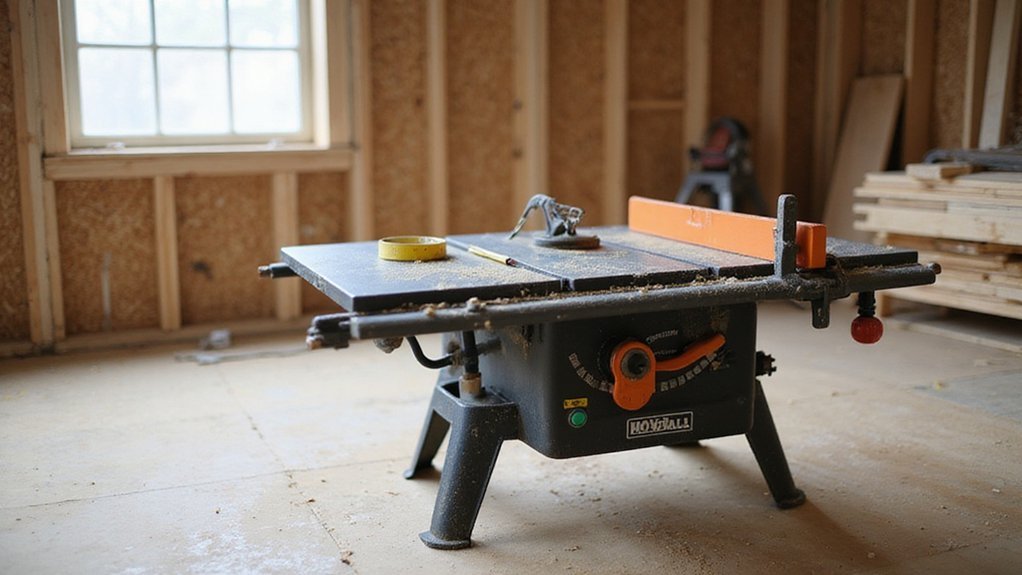
Before you commit to a commercial table saw, you’ve got to match the machine to your workload, and that means weighing five critical factors: power and motor size, blade size and capacity, durability and build quality, portability and footprint, and the safety systems that come standard. You don’t want a motor that bogs down on hardwoods, nor do you want a monster you can’t move around a job site, so start by asking yourself what your daily cuts actually demand. And remember, a heavier cast-iron top isn’t just for looks; it’s your best defense against vibration, while features like a riving knife and flesh-sensing brake can save your fingers, not just your project.
Power & Motor Size
Two key specs dominate this decision: horsepower (HP) and voltage. Your motor’s HP directly dictates cutting torque, so for thick hardwoods or stacked laminates, aim for 5 HP to 7 HP or more; that muscle prevents bogging down mid-cut. Higher HP also means less strain during marathon sessions, extending your saw’s lifespan.
Voltage matters just as much. Most commercial models run on 230V or 460V, so check your shop’s breaker panel first. A 5 HP motor on 230V handles nearly everything, but 460V gives you smoother starts and lower amperage draw, which is kinder to your wiring.
Don’t ignore RPM either. Around 4,500 RPM delivers that clean, chip-free finish you want, balancing speed with blade stability. Match those numbers to your power source, and you’ll have a saw that eats through work without blinking.
Blade Size & Capacity
First up, your blade size sets the stage for what you can actually cut. You’ll typically see 10-inch or 14-inch diameters; bigger blades mean deeper cuts and larger rip capacity, but they also demand beefier motors. That direct trade-off shapes your workflow.
Your saw’s capacity, like maximum cut height and rip width, hinges on that blade. Pick a 14-incher if you’re ripping thick hardwoods or sheet goods in one pass, but know it’ll eat up more floor space and complicate portability.
- Match blade size to your usual stock: 10-inch for framing, 14-inch for heavy timber.
- Consider your shop footprint before committing to a larger footprint.
Align that choice with your daily projects, and you’ll cut safely and efficiently every time.
Durability & Build Quality
Now that you’ve matched your blade size and capacity to your typical stock, let’s talk about what makes a commercial table saw truly worth your investment: durability and build quality. You want a saw built like a tank, with heavy-duty cast iron or steel components that shrug off daily abuse. High-grade carbide blades and reinforced trunnions directly boost longevity and cut performance. Look for reinforced safety features like quick-release riving knives and sturdy blade guards; they’re not just for safety, they uphold structural integrity during heavy use. A robust frame with a wide, stable base minimizes vibrations, giving you precise cuts every time. And don’t overlook weather-resistant coatings and corrosion resistance. They guarantee your saw delivers reliable performance for years, even in demanding workshop environments. Choose wisely, and you won’t regret it.
Portability & Footprint
Three key factors determine how well a saw fits your workflow: weight, dimensions, and mobility features. You’ll want a portable model with foldable or wheeled stands if you’re bouncing between job sites; a compact footprint lets you squeeze into tight corners without sacrificing cut capacity. Heavier, stationary saws, though rock-solid during use, might require a second set of hands or a lift to move, so weigh that against your frequency of travel. Check the casters and stand quality, too, because they’ll determine if you’re gliding or wrestling. For daily shuffling, prioritize foldable legs and locking wheels. For a permanent shop corner, stability wins. Match the saw’s footprint to your actual space, not your ideal one, and you’ll thank yourself later.
Safety Systems Included
Modern commercial table saws pack in an arsenal of safety tech that can feel like a cockpit control panel, but here’s the deal: you don’t need every bell and whistle, just the ones that actually save your fingers. Prioritize a riving knife and anti-kickback pawls; they’re your first line against the nasty stuff. Look for an electronic blade brake that stops the spin in under a second, not a slow coast-down. Magnetic interlock switches kill power instantly if you lose grip, and anti-restart switches prevent surprise starts after a blackout. Check for a digital readout that confirms blade angle and height, keeping your settings precise without guesswork. You’ll also want an oversized emergency stop button, easy to slap even with gloves on. Skip gimmicks, but don’t skimp on these core shields. Your digits will thank you.
Dust Collection Efficiency
Why let sawdust turn your workshop into a hazmat zone when you can nail down dust collection efficiency from the start? You want a table saw with a high-capacity port and serious suction power to capture debris right at the source. That’s non-negotiable. Look for a design that minimizes airborne dust; a well-sealed system keeps your workspace cleaner and safer. But how effective is it, really? You can gauge this by the percentage of dust it successfully removes during operation. For best results, guarantee compatibility with standard shop vacuums or dust extraction systems. That compatibility simplifies maintenance and boosts performance. And don’t slack on upkeep: regularly check seals and clean components to sustain that high efficiency over time. A clean shop starts with smart choices now.
Warranty & Support
A dusty shop handled, now let’s talk about what happens when the blade stops spinning for the wrong reason. You need a extensive warranty, typically 1 to 5 years, shielding you from costly manufacturing defect repairs. Don’t overlook support services: customer helplines, online tutorials, and easy parts replacement are lifelines for troubleshooting mid project.
- Verify if extended warranties or service plans are available for prolonged coverage.
- Strong support networks minimize downtime during emergencies, keeping you on schedule.
- Review the warranty’s terms carefully. Note coverage scope, registration requirements, and claim procedures to avoid disputes later.
It’s like having a savvy backup plan. A little upfront reading saves you big headaches when a motor sputters or a fence jams. That peace of mind? Worth every penny.