When you're diving into woodworking, having the right tools makes all the difference. Among these, a reliable random orbital sander is essential for achieving that smooth, professional finish. Expert craftsmen have highlighted three standout models: the BOSCH ROS20VSC, SKIL's 5" Random Orbital Sander, and the Dong Cheng 5-Inch Sander. Each offers unique strengths tailored to different needs. Curious about what sets these sanders apart and which might be your perfect match?
key Takeaways
- BOSCH ROS20VSC offers a smooth, swirl-free finish with its pad dampening system, making it ideal for woodworking projects.
- SKIL 5" Random Orbital Sander features an ergonomic design and effective dust collection, enhancing user experience and workspace cleanliness.
- Dong Cheng 5-Inch Sander combines affordability with high performance and build quality, suitable for diverse woodworking tasks.
- Variable speed control and ergonomic grips in these sanders provide precision and comfort during extended woodworking sessions.
- High dust collection efficiency in these models ensures minimal mess and protects the user's health in woodworking environments.
BOSCH ROS20VSC Palm Sander with Dust Collector and Carrying Bag


If you're a woodworking enthusiast or a professional looking for a reliable and efficient sander, the BOSCH ROS20VSC Palm Sander with Dust Collector and Carrying Bag is a standout option. This 2.5 Amp, 5-inch corded sander offers variable speed control, allowing you to match the task with speeds from 7,500 to 12,000 OPM. Its pad dampening system guarantees a smooth finish without swirl marks. You'll appreciate the easy disc attachment with Bosch's Hook and Loop system. The microfilter dust collection system effectively traps small particles, reducing cleanup time. Its compact design and comfortable grip make it ideal for tight spaces.
Best For: Woodworking enthusiasts and professionals seeking a reliable, efficient sander with excellent dust collection and a smooth finish.
Pros:
- Effective dust collection system with microfilter traps particles as small as 1/2-micron.
- Variable speed control for task-specific performance.
- Lightweight and compact design with a comfortable grip for maneuverability.
Cons:
- Dust canister fills quickly on larger jobs, requiring frequent emptying.
- May not be as ergonomic or controllable as some other models.
- Twist-off dust canister may be difficult to see through due to dust accumulation.
SKIL 5" Random Orbital Sander (SR211601)

The SKIL 5" Random Orbital Sander (SR211601) is an excellent choice for woodworking enthusiasts seeking a reliable and powerful tool. With a 2.8 amp motor and variable speed range of 7,000-13,000 OPM, you can tackle various sanding tasks effortlessly. Its ergonomic design, featuring a soft rubber grip, guarantees comfort and reduces hand fatigue. The X-Flow Dust Collector, although with 60% efficiency, keeps your workspace cleaner. Users love its lightweight design and quick hook-and-loop attachment system. Garnering high ratings, this sander's compactness makes it perfect for tight spaces, offering a swirl-free finish on wood, metal, and plastic surfaces.
Best For: DIY enthusiasts and professionals looking for an affordable, efficient, and compact sander for various sanding tasks in tight spaces.
Pros:
- Powerful 2.8 amp motor with variable speed control for versatile applications.
- Ergonomic design with a soft rubber grip reduces hand fatigue during extended use.
- Compact and lightweight, making it easy to maneuver and perfect for tight spaces.
Cons:
- Dust collection system has only 60% efficiency, which could be improved.
- Some users reported initial packaging issues.
- The dust collector may require frequent emptying during extensive sanding sessions.
Dong Cheng 5-Inch Random Orbital Sander with 20pcs Sandpaper
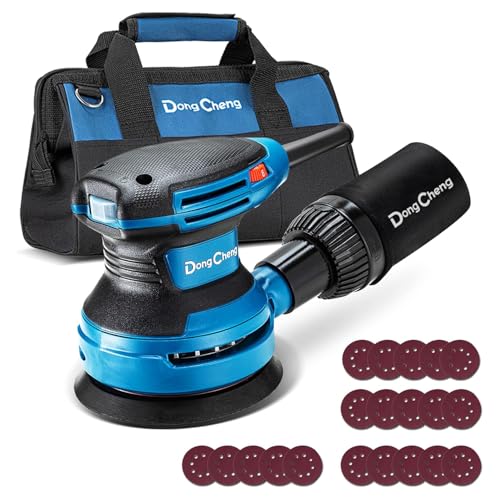
For woodworking enthusiasts seeking a reliable and efficient tool, the Dong Cheng 5-Inch Random Orbital Sander with 20pcs Sandpaper stands out as an excellent choice. With a powerful 380W motor and speeds ranging from 8000 to 12800 OPM, you can tackle diverse projects effortlessly. The ergonomic rubber handle guarantees comfort, while the 5-inch pad efficiently sands large surfaces. Quick sandpaper changes are a breeze with the hook-and-loop design. It includes a detachable dust bag compatible with vacuum systems, which makes cleanup easy. Users rave about its build quality and performance, praising its efficiency and affordability for DIY projects.
Best For: Woodworking enthusiasts and DIYers looking for an affordable, efficient, and reliable sander with features typically found in higher-end models.
Pros:
- Powerful 380W motor with variable speeds for versatile sanding
- Efficient dust collection with detachable dust bag and vacuum compatibility
- Ergonomic design with rubber handle for comfortable use
Cons:
- Limited to 120 volts AC power supply
- May not be ideal for heavy-duty professional use
- Dust bag may require frequent emptying during extensive projects
Factors to Consider When Choosing a Random Orbital Sander for Woodworking
When you're choosing a random orbital sander for woodworking, consider the power and performance to guarantee it meets your project's demands. Look for models with speed variability options and ergonomic design features for comfortable, efficient use. Don't forget about dust collection efficiency and overall ease of use to keep your workspace clean and your tasks straightforward.
Power and Performance
Although selecting the right random orbital sander might seem intimidating, focusing on power and performance can simplify your decision. First, consider the sander's power, usually measured in amps. A range of 2.5 to 2.8 amps generally delivers effective performance for a variety of sanding tasks. Additionally, look for a sander with a high maximum speed, between 12,000 to 13,000 OPM, which guarantees faster sanding and smoother finishes. It's essential to choose a model with a design that minimizes vibrations. Less vibration means better control and comfort during long projects. Finally, an effective motor and dust collection system enhance overall performance by providing efficient sanding and maintaining a cleaner workspace. These factors will guide you in selecting a high-performing sander.
Speed Variability Options
Speed variability is an important aspect to take into account when choosing a random orbital sander for woodworking. Models typically offer options ranging from 7,000 to 13,000 OPM, letting you adjust speeds based on material needs. Higher-end sanders often provide precise variable speed controls for specific RPM settings, allowing you to customize sanding tasks. Look for a soft-start feature, which gradually ramps up speed to prevent swirl marks, ensuring a smooth finish. The hook-and-loop system facilitates quick sandpaper changes, helping you switch effortlessly between grits and maintain the appropriate speed for the task. Matching speed settings to your project is vital for achieving the best results, whether you're working on flat surfaces or intricate contours.
Ergonomic Design Features
Choosing a random orbital sander with ergonomic design features can greatly enhance your woodworking experience. Look for sanders with a soft rubber grip, which reduces hand fatigue and lets you work longer without discomfort. A compact design is important for maneuverability, allowing you to navigate tight spaces with precision and control. Pay attention to weight distribution; a well-balanced sander minimizes vibration and guarantees smoother operation. Features like a dust-sealed on/off switch can add to your comfort by reducing the hassle of cleaning during use. Additionally, ergonomic sanders often offer easy sandpaper changes, streamlining your workflow and improving the overall user experience. With these features, you'll enjoy a more efficient and enjoyable sanding process.
Dust Collection Efficiency
When selecting a random orbital sander, dust collection efficiency is a crucial factor that can't be overlooked. An effective dust collection system reduces mess and cleanup time, keeping your workspace cleaner and enhancing your overall sanding experience. Look for sanders equipped with microfilter systems or cyclone force technology; these features trap finer particles, improving air quality while you work. The dust collection container's design should allow for easy visibility and quick emptying, preventing interruptions during larger projects. Also, consider models that can operate with or without a vacuum, offering flexibility based on project needs and personal preferences. A higher dust collection efficiency rating, ideally around 60% or more, indicates superior performance in minimizing dust during your sanding tasks.
Ease of Use
After ensuring your workspace remains dust-free, it's time to focus on the ease of use when selecting a random orbital sander for woodworking. A lightweight design, ideally around 3.3 to 3.5 pounds, makes the sander easier to maneuver, reducing fatigue over long periods. Look for sanders with ergonomic handles and soft rubber grips for improved comfort and control, enabling you to sand with precision. Quick attachment systems like hook-and-loop designs simplify sandpaper changes, minimizing downtime. Variable speed controls let you tailor the sander's performance to different materials, enhancing its versatility. Effective dust collection features, such as detachable dust bags or built-in vacuums, further simplify your sanding experience by keeping your workspace clean and reducing cleanup time.
Included Accessories
Accessories can make a significant difference when picking a random orbital sander for woodworking. Consider the included accessories like sanding pads and dust collection systems, as they enhance functionality and ease of use. A quality sander should come with a variety of sanding sheets in different grits, providing versatility for various tasks. Efficient dust management is essential, so look for sanders with a dust canister or bag to trap particles and maintain a clean workspace. Vacuum adapters are valuable for connecting to external dust systems, further improving dust control. Additional items like carrying bags or user manuals add convenience and value, ensuring you get the most out of your sander. These accessories can greatly impact your sanding experience.
Durability and Build Quality
In addition to accessories, the durability and build quality of a random orbital sander are essential for woodworking enthusiasts. You should pay attention to the materials used in its construction; high-quality plastics and metals can enhance its longevity. A robust motor, typically rated at 2.5 to 2.8 amps, guarantees the sander can handle various tasks without overheating, indicating superior build quality. Ergonomic designs and rubber grips not only improve comfort but also add to the tool's sturdiness during long projects. Opt for sanders with a hook-and-loop sanding pad system for easy pad replacement, minimizing wear. Finally, a solid dust collection system is vital to prevent dust buildup, protecting internal components and extending the lifespan of your sander.
Price and Value
How do you determine if a random orbital sander is worth its price? Start by considering the features offered. Higher-priced models often boast advanced dust collection and variable speed settings, enhancing both performance and user experience. Check if the sander includes accessories like sanding sheets or a carrying bag, as they boost value without greatly raising costs. Look at the warranty period; longer warranties usually suggest better build quality, offering peace of mind. Compare weight and ergonomics to guarantee comfort and reduce fatigue, which can justify a higher price. Finally, analyze user reviews and ratings to verify satisfaction and performance align with the price. This approach helps you invest in a sander that truly meets your woodworking needs.