Choosing a rip blade isn’t just about tooth count, it’s about cut quality, feed speed, and heat management. You want a blade that powers through hardwoods without burning, stays sharp through long sessions, and leaves a finish you can glue immediately. It’s a big decision with real consequences for your project. Let’s look at the ten blades pros actually reach for.



More Details on Our Top Picks
Freud Heavy-Duty Rip Saw Blade – 10″ Diameter 24 Teeth 5/8″ Arbor
For serious woodworkers tackling thick hardwoods or softwoods from 3/4 to 2-3/4 inches, this blade is your heavy-duty pro workhorse. You’ll get smooth, fast rip cuts with a clean, splinter-free finish ideal for glue line work. That means less sanding and jointing for you. Its 24 TiCo carbide teeth stay sharp longer, and the large gullets eject chips effortlessly, reducing motor strain. The Perma-Shield coating fights corrosion and pitch buildup. You also benefit from:
- Laser cut anti-vibration slots for truer cuts
- Extra large teeth for more sharpening cycles
- Limited lifetime warranty for peace of mind
And yes, it handles chipboard and plywood too, though expect some finish variation outside its ideal range.
- Diameter:10 inches
- Number of Teeth:24
- Arbor Size:5/8 inch
- Tooth Grind/Design:Flat-top (FTG)
- Kerf Width:0.126 inches
- Material Compatibility:Hardwoods, softwoods 3/4-2-3/4 inch thick, chipboard, plywood, laminate
- Additional Feature:Perma-Shield non-stick coating
- Additional Feature:Large gullets for chip ejection
- Additional Feature:Pretensioned for heavy loads
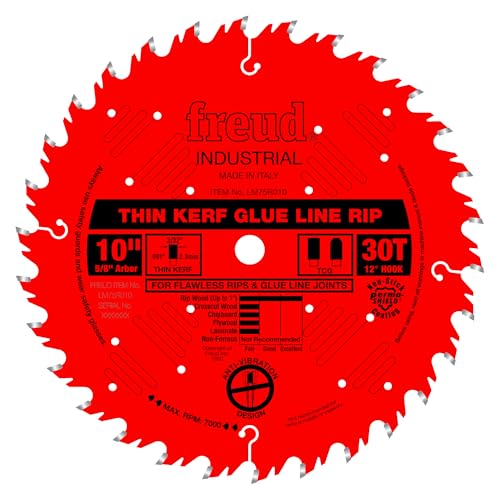
Freud LM75R010: 10″ Industrial Thin Kerf Glue Line Ripping Blade Carbide
Every thin kerf specialist knows the struggle: a ripping blade that wanders, chatters, or leaves a ragged edge you must sand away. Freud’s LM75R010 solves that. It’s a 10-inch industrial thin kerf glue line ripping blade, built with 30 teeth and a triple chip grind. You get smooth, true-cut surfaces for glue-up work, no jointing needed. The TiCo Hi-Density Carbide stays sharp, and the Perma-Shield coating fights pitch build-up and corrosion. Laser-cut anti-vibration slots kill chatter, so you rip straight and clean. And with a .091-inch kerf, you save material without sacrificing stability.
- Diameter:10 inches
- Number of Teeth:30
- Arbor Size:5/8 inch
- Tooth Grind/Design:Triple chip (TCG)
- Kerf Width:0.091 inches
- Material Compatibility:Wood and similar materials 1/8-1 inch thick
- Additional Feature:Triple chip tooth design
- Additional Feature:12° hook angle
- Additional Feature:Thin kerf .091 inches
FOXBC 10-Inch Ripping Table Saw Blade
You’re ripping thick hardwoods or sheet goods all day, so the FOXBC 10-Inch Ripping Table Saw Blade is the value pick that won’t let you down. Its 24 flat teeth and thin .094-inch kerf slice through stock fast, wasting less material while your saw motor runs cooler. You’ll get clean cuts in plywood, chipboard, or laminates from 3/4 to 2-3/4 inches thick, with minimal vibration thanks to that 20° hook angle. The tungsten carbide tips stay sharp through heavy use. It fits 5/8-inch arbors on DeWalt, Makita, and more. At 4.7 stars from 214 users, it’s proof you don’t need to overspend for pro-grade ripping.
- Diameter:10 inches
- Number of Teeth:24
- Arbor Size:5/8 inch
- Tooth Grind/Design:Flat tooth
- Kerf Width:0.094 inches
- Material Compatibility:Hardwoods, softwoods 3/4-2-3/4 inch thick, plywood, chipboard, laminates
- Additional Feature:High-density tungsten carbide
- Additional Feature:20° tooth hook angle
- Additional Feature:Thin kerf .094 inches
10-Inch 24T Carbide Table Saw Blade with 5/8-Inch Arbor for Ripping
This 10-inch, 24-tooth carbide blade is your budget-friendly pick for fast, efficient ripping. Its universal 5/8-inch arbor fits Makita, Milwaukee, and Skill saws, plus miter saws, so you’re covered across your shop. You’ll get clean, burr-free cuts through hardwood, softwood, plywood, or composites, handling both rough ripping and finer work without swapping tools.
The tungsten carbide teeth, brazed for durability, stay sharp longer than typical dado blades. A thin 0.094-inch kerf cuts resistance, noise, and vibration down to a whisper. You’re looking at a stable 6800 RPM operation, which keeps your feed smooth. Weighing just 0.82 kg, it’s light to handle. Rated 4.7 out of 5 by users, it’s a proven workhorse for the price.
- Diameter:10 inches
- Number of Teeth:24
- Arbor Size:5/8 inch
- Tooth Grind/Design:Tungsten carbide teeth (not specified grind)
- Kerf Width:0.094 inches
- Material Compatibility:Hardwood, softwood, plywood, composites
- Additional Feature:Brazing technology for teeth
- Additional Feature:High stability 6800 RPM
- Additional Feature:Burr-free cut design
DEWALT 10 in. 24 Tooth Carbide Saw Blade
The DEWALT DWA11024 is the most popular ripping blade for DIYers tackling weekend projects. You get a 10 inch, 24 tooth carbide tipped blade that cuts through hardwood, softwood, trim, and plywood with crisp, clean precision. Its optimized tooth geometry boosts accuracy and efficiency, while the ultra sharp carbide tips last up to three times longer than standard blades. And it’s lightweight at just 12.8 ounces, so it won’t bog down your saw. Here’s what it handles best:
- Hardwood and softwood ripping
- Trim and sheet materials
- OSB and plywood
Just mount it and rip away!
- Diameter:10 inches
- Number of Teeth:24
- Arbor Size:5/8 inch
- Tooth Grind/Design:Carbide-tipped (not specified grind)
- Kerf Width:Not specified
- Material Compatibility:Hardwood, softwood, trim, plywood, OSB, sheet material
- Additional Feature:Ultra-sharp carbide tips
- Additional Feature:Three times longer lifespan
- Additional Feature:Optimized tooth geometry
CRAFTSMAN 10-Inch 24T Carbide Saw Blade (CMAS21024)
Framing jobs call for fast, aggressive cuts. You’ll get exactly that with CRAFTSMAN’s CMAS21024, a 10-inch, 24-tooth framing ripping blade that doesn’t mess around. Those induction-brazed carbide tips? They’re built to last, so you won’t be swapping blades mid-project. Ground teeth deliver smooth, accurate rips. Plus, the corrosion-resistant coating fights rust, and the heat-treated plate resists warping under tough use. It’s even good for composite decking. This red blade is a workhorse for your table or miter saw. No fluff, just solid, reliable cuts. Perfect for pros who need speed without sacrificing precision.
- Diameter:10 inches
- Number of Teeth:24
- Arbor Size:5/8 inch
- Tooth Grind/Design:Carbide tips (not specified grind)
- Kerf Width:Not specified
- Material Compatibility:Composite decking, framing lumber, wood
- Additional Feature:Induction-brazed carbide tips
- Additional Feature:Heat-treated steel plate
- Additional Feature:Corrosion-resistant coating
CMT Orange Tools Ripping Saw Blade 10
Looking for a ripping blade that handles serious production work without bogging down? The CMT Orange Tools 201.024.10 brings German steel with a 46-48 Rockwell hardness to your table. Its 24 teeth, set with a 20-degree hook, power through hardwood or plywood, leaving glue-line ready edges.
- Built tough: Tri-metal brazing and laser-cut expansion slots fight warping and vibration, so you get smooth, quiet cuts.
- Safer by design: Anti-kickback shoulders let you feed aggressively without the fear of a nasty surprise.
- Fits your shop: It works with portable, radial arm, and miter saws, all wrapped in a handy plastic case.
You’ll appreciate the orange PTFE coating too; it reduces friction and keeps resin from sticking. At 0.09 inches thick, it’s stable and true. Just mount it, dial in your fence, and rip with confidence. It’s a workhorse that won’t quit mid-project.
- Diameter:10 inches
- Number of Teeth:24
- Arbor Size:5/8 inch
- Tooth Grind/Design:Flat-top ground (FTG)
- Kerf Width:Not specified (blade thickness 0.09 inches)
- Material Compatibility:Softwoods, hardwoods, plywood, OSB, veneered plywood, wood materials
- Additional Feature:Tri-metal brazing technology
- Additional Feature:Anti-kickback shoulder design
- Additional Feature:PTFE non-stick coating
CMT Orange Tools Ripping Saw Blade 10
If you rip a lot of hardwoods, this is your industrial choice. You’re getting a 10 inch, 24 tooth blade with a flat top grind that chews through stock fast. The kerf is a slim 0.126 inches, so you waste less material and your saw won’t struggle. Pros rating it 4.8 stars across 147 reviews? That’s trust. Furniture makers and CNC shops rely on this for a reason. The carbide tips stay sharp, and the steel body holds true. Just match the 5/8 inch bore to your arbor and go. No fuss. No tear out.
- Diameter:10 inches
- Number of Teeth:24
- Arbor Size:5/8 inch
- Tooth Grind/Design:Flat tooth
- Kerf Width:0.126 inches
- Material Compatibility:Wood cutting for industrial applications
- Additional Feature:Heavy-duty industrial use
- Additional Feature:Compatible with CNC machinery
- Additional Feature:Flat tooth style
Diablo 10″ 24 Tooth Ripping Saw Blade
This ripsaw blade earns editor’s choice for professional framers. You’re getting a 10-inch, 24-tooth design with a thin .098-inch kerf that slashes through pressure-treated lumber and OSB without bogging down your saw. The 15° hook angle aggressively pulls material, so ripping long boards feels effortless. Hi-density carbide tips with TiCo formula stay sharp four times longer than standard steel, and the Perma-Shield coating prevents pitch buildup, meaning less downtime for cleaning. Stabilizer vents cut vibration, keeping your cuts straight and your hands steady. It fits table, miter, and circular saws alike. For fast, clean framing work, you won’t find a more reliable workhorse.
- Diameter:10 inches
- Number of Teeth:24
- Arbor Size:5/8 inch
- Tooth Grind/Design:Alternate-top bevel (ATB)
- Kerf Width:0.098 inches
- Material Compatibility:Rough framing lumber, finish lumber, plywood, OSB, hardboard siding, engineered wood
- Additional Feature:Hi-Density TiCo carbide
- Additional Feature:Stabilizer vent design
- Additional Feature:15° hook angle
CMT ITK XTreme 10-Inch Ripping Saw Blade
The CMT ITK XTreme 10-Inch Ripping Saw Blade is your go-to for unmatched durability in tough ripping jobs. Its micrograin carbide teeth, bonded with a copper-silver-copper trimetallic bond, resist dulling and damage. You’ll appreciate the thin kerf (just 0.102 inches), which removes less material, so you get more cuts per resharpening and less strain on your saw. The tooth configuration is smart: one flat-top tooth followed by two 15-degree alternating top bevel teeth. This setup minimizes heat buildup. Plus, the laser-cut steel plate, hardened to 46-48 Rockwell, has expansion slots to reduce noise and vibration. Use it for softwoods, hardwoods, or plywood. It’s delivered in a protective CMT case.
- Diameter:10 inches
- Number of Teeth:24
- Arbor Size:5/8 inch
- Tooth Grind/Design:One FTG tooth + two 15° ATB teeth
- Kerf Width:0.102 inches
- Material Compatibility:Softwood, hardwood, plywood, OSB, pressed treated wood
- Additional Feature:Micrograin carbide teeth
- Additional Feature:Trimetallic bond brazing
- Additional Feature:Anti-kickback design
Factors to Consider When Choosing Table Saw Blade Ripping
When you’re picking a ripping blade, start by focusing on three key factors: tooth count and type, kerf width impact, and hook angle selection. A lower tooth count (like 24 teeth) clears waste faster for aggressive rips, while a positive hook angle pulls the wood through, but a thinner kerf wastes less material and puts less strain on your saw. Don’t overlook blade material quality either, and always check that the arbor size matches your saw’s shaft.
Tooth Count & Type
Because you’re looking for speed and efficiency when ripping, tooth count is your first major decision point. You’ll typically find ripping blades with 24 to 30 teeth. Fewer teeth mean faster, more aggressive cuts with less motor strain. That’s your sweet spot for pure speed.
Now, tooth type matters just as much. You want flat-top (FT) or trapezoidal grind (TG) teeth. They’re durable and excel at removing material quickly, exactly what ripping demands. For smoother cuts, an alternating top bevel (ATB) design reduces tear-out, but it slows you down. Triple chip grind (TCG) teeth? Those handle tough materials like laminates.
Kerf Width Impact
While you’re dialing in tooth count and type, kerf width quietly shapes your ripping experience even more than you might expect. A narrower kerf cuts less material, so you’ll waste less wood and save your saw’s motor some strain. That means smoother operation and easier workpiece handling, especially if you’re on a lower-powered saw. But here’s the trade-off: a wider kerf gives you more stability and less vibration, which means cleaner, more precise cuts. The downside is more heat and friction, which can shorten blade life and roughen your finish. So, think about your priorities:
- Need power savings and less waste? Go thinner.
- Chasing ultimate precision? A wider kerf might be your friend.
Ultimately, balance your saw’s horsepower with your material and cut quality goals.
Blade Material Quality
High quality blade materials are key if you want your ripping blade to hold up through tough cuts and keep performing over time. You’ll want micrograin carbide or hardened steel here, as they offer serious durability and resist wear even when you’re pushing through dense hardwoods. These materials help your blade maintain a sharp edge longer, so you won’t need to resharp it as often. Plus, they handle high temperatures and friction without warping, giving you consistent performance cut after cut. Premium construction also fights corrosion and pitch buildup, which keeps your cuts precise and your finish smooth. If you choose a blade with cheap steel or lower grade carbide, you’ll replace it sooner. Invest in better material quality, and you’ll get a longer lifespan and better results every time you rip.
Hook Angle Selection
When you’re picking a ripping blade, hook angle is one of those details that can make or break your cut. For aggressive ripping through softwoods or hardwoods, a higher hook angle (20° to 25°) gives you faster cuts and better chip clearance. But beware: it’ll create more tear-out on delicate surfaces, so skip it when finish matters. For precise ripping tasks, a lower hook angle (around 15°) delivers smoother cuts and reduces kickback risk. Steeper angles also mean less resistance, though they increase binding potential. So, match your choice to your priority: speed, finish quality, or safety? For most pros, it’s a trade-off.
Arbor Compatibility
Before you lock in a ripping blade, arbor compatibility is a must check. That hole in the center? It’s got to match your saw’s arbor exactly. Most saws use a 5/8 inch or a 1 inch arbor. Stick a blade with the wrong arbor on there, and you’re asking for trouble: unsafe operation, nasty vibration, and cuts that look like a drunken beaver made them.

Welcome to WoodCraftYard.com, your one-stop destination for all things woodworking! I’m Oliver Candler, a dedicated woodworking aficionado and the creative mind behind this virtual woodworking haven. With a deep-rooted love for craftsmanship and a keen eye for detail, I am on a mission to share my passion for woodworking with fellow enthusiasts like yourself.
As a seasoned woodworker, I am committed to providing you with valuable insights, practical tips, and inspiring project ideas to help you unleash your creativity and master the art of woodworking. Whether you’re a seasoned pro or just starting out on your woodworking journey, join me as we carve, sand, and saw our way through the world of woodworking together.
Let’s embark on this woodworking adventure, where every knot, grain, and finish tells a unique story. Together, let’s craft, create, and build something truly extraordinary at WoodCraftYard.com!