You’ll find that choosing the right finger joint jig for your table saw can make or break your woodworking projects. Whether you’re crafting elegant boxes or sturdy furniture pieces, the precision and consistency of your joints depend heavily on your jig selection. From versatile spline jigs to adjustable box joint systems, today’s market offers solutions for every skill level and project type. Let’s explore three standout options that’ll elevate your joinery game.
Woodpeckers Spline Jig for Router Table & Table Saw


If you’re looking for a versatile and precision-engineered jig that works on both table saws and router tables, the Woodpeckers Spline Jig stands out as a top choice. Made in the USA, this high-quality tool features aluminum Super Track sections and powder-coated steel legs with UHMW glide strips.
You’ll appreciate its impressive capacity, handling projects from 1/2 to 16 inches wide, with the option to expand to 3 feet. The jig’s four molded flip stops guarantee precise alignment, while its dual-purpose design lets you create narrow splines on your table saw or switch to wider splines and dovetails on your router table.
Best For: Experienced woodworkers and hobbyists seeking a precise, versatile jig for creating strong, decorative spline and dovetail joints on both table saws and router tables.
Pros:
- Premium construction with aluminum tracks and powder-coated steel legs ensures durability and smooth operation
- Versatile design works on both table saws and router tables with capacity from 1/2″ to 16″ (expandable to 3 feet)
- Made in USA with high manufacturing standards and excellent customer support
Cons:
- Premium price point may be steep for casual woodworkers
- Requires some initial setup and familiarization time
- Limited to straight-line joints and splines (not suitable for curved work)
General Tools Woodworking Dovetail Jig (12 Template Kit)
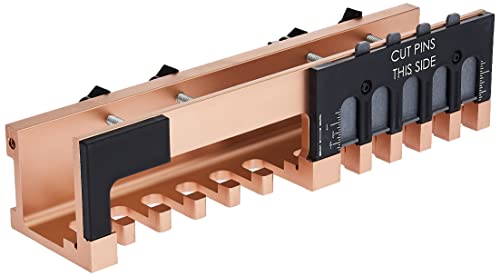
The General Tools Woodworking Dovetail Jig strikes an ideal balance between versatility and user-friendliness, making it a smart choice for both novice woodworkers and seasoned professionals.
This aluminum jig features a 1-piece layout design that guarantees even joint matching and includes a 14-degree, 1/2-inch dovetail router bit. You’ll appreciate its integrated clamping system that accommodates various board widths without needing to bolt it to your workbench. The micro jig interface lets you adjust for loose or tight joints, while the control knobs deliver precise operation. While it’s primarily designed for router use, you’ll find it especially effective for creating half-blind, through dovetail, and box joints.
Best For: Woodworking enthusiasts and professionals seeking an affordable, versatile dovetail jig for creating precise joints in furniture and cabinetry projects.
Pros:
- Versatile design allows for multiple joint types including half-blind, through dovetail, and box joints
- Integrated clamping system eliminates need for permanent workbench mounting
- Adjustable micro jig interface provides control over joint tightness
Cons:
- Included router bit may need upgrading for better performance with harder woods
- Some users report challenges with the clamping system
- Plastic pin guides may wear over time, especially with frequent use
Router Table Box Joint Jig with Three Finger Widths

Woodworkers seeking versatility will appreciate Rockler’s Router Table Box Joint Jig with its three interchangeable finger widths of ¼”, ⅜”, and ½”. This stable MDF jig features a low-friction melamine coating and locks securely into a ¾” miter slot with easy-grip knobs.
You’ll find the glass-filled nylon sled glides smoothly, maintaining perfect squareness to your router bit. The included brass indexing keys guarantee uniform finger spacing, while the sacrificial fence face controls tear-out. At just 3.78 pounds, it’s lightweight yet durable. Users praise its precision, though they recommend using setup blocks and digital calipers for the most accurate results.
Best For: Intermediate woodworkers looking to create precise box joints in small to medium-sized projects who want flexibility in joint sizes and have access to a router table.
Pros:
- Three versatile finger widths (¼”, ⅜”, ½”) accommodate different project needs
- Low-friction melamine coating and glass-filled nylon sled ensure smooth operation
- Secure locking mechanism with easy-grip knobs provides stability during use
Cons:
- Requires additional setup blocks and measuring tools for optimal accuracy
- Limited to ¾” miter slot compatibility
- May need frequent cleaning to prevent material buildup affecting joint alignment
Factors to Consider When Choosing a Finger Joint Jig for Table Saw
When selecting a finger joint jig for your table saw, you’ll want to evaluate several key factors that impact performance and usability. You should check the jig’s material quality and durability, size capacity, precision controls, and how easily you can set it up for different projects. Your chosen jig must also be compatible with your specific table saw model and blade configurations to guarantee accurate, repeatable cuts.
Material Quality and Durability
Material quality’s impact on your finger joint jig’s performance can’t be overstated. When selecting a jig, you’ll want to focus on models featuring aluminum or high-grade MDF construction, as these materials deliver superior durability and consistent performance over time.
Look for jigs that incorporate glass-filled nylon components, which offer excellent wear resistance and maintain their precision through repeated use. If you’re considering steel components, choose ones with powder-coated finishes to protect against scratches and environmental damage. These protective features guarantee your jig won’t warp or fail structurally during intensive woodworking sessions. By investing in a jig with high-quality materials and durable construction, you’ll secure a tool that maintains its accuracy and reliability across numerous projects, ultimately saving you time and money.
Size and Capacity Limits
Three critical size factors shape your finger joint jig selection: board width capacity, adjustability range, and overall footprint dimensions. You’ll want to choose a jig that handles your typical board widths, with most models accommodating ½ inch to 16 inches of material.
For larger projects, look for jigs with adjustable features that extend beyond standard capacities, allowing you to work with pieces up to 3 feet wide. The jig’s footprint must fit comfortably on your table saw while leaving enough workspace for safe operation. Don’t forget to check the jig’s indexing capability – many come with interchangeable keys for creating different finger widths. This versatility lets you match joint sizes to your project requirements while maintaining stable positioning and precise alignment.
Adjustability and Precision Controls
Precision control features stand at the forefront of any quality finger joint jig selection. You’ll want to focus on models that offer adjustable clamps and indexing keys, letting you work with various board widths while maintaining perfect alignment. The best jigs come with micro-adjustment capabilities, so you can fine-tune your joints for either tight or loose fits based on your project needs.
Look for interchangeable indexing keys that’ll help you achieve uniform finger spacing across different workpieces. It’s essential to choose a jig that maintains squareness to your router bit, as this guarantees accurate cuts every time. Don’t overlook the importance of reliable locking mechanisms – they’ll keep your setup stable throughout the cutting process and help you achieve consistently professional results.
Ease of Setup
When selecting a finger joint jig for your table saw, setup convenience should be a top priority. You’ll want a jig that features integrated clamping mechanisms, eliminating the need to bolt it to your workbench. Look for models with smooth-sliding platforms and low-friction surfaces that allow for quick, precise adjustments without resistance.
Choose a jig with adjustable components like micro jig interfaces or interchangeable indexing keys, as they’ll provide flexibility across different project specifications. These features make it easier to adapt the jig to various tasks without complicated reconfigurations. Don’t overlook the importance of clear instructions – whether through included manuals or online resources. A well-documented setup process will help you maximize the jig’s potential and get started on your projects faster.
Compatibility With Tools
Selecting a compatible finger joint jig for your table saw requires careful consideration of several technical specifications. You’ll need to verify that the jig’s miter slot width matches your saw’s dimensions and check if any router base requirements align with your existing tools.
When evaluating compatibility, make sure the jig can handle your typical stock dimensions. Look for models with adjustable features that accommodate various wood thicknesses and widths. If you’re working with different joint sizes, you’ll want a jig with interchangeable indexing keys or adjustable spacing options. The jig’s construction material matters too – especially if you’re cutting hardwoods regularly. Pay attention to alignment features, as they’ll directly impact your joint accuracy. A jig that’s easy to set up with your specific saw will save you time and frustration.