If you crave clean, accurate cuts in delicate materials, a standard saw won’t cut it. You need a compact workhorse designed for precision, not power. From glass to hardwoods, the right small band saw transforms tricky projects. We’ve identified four models crafters genuinely trust, starting with a portable 9-inch workhorse.
| Portable 9-Inch Bandsaw for Woodworking 2526 FPM | Best Overall | Motor Power: 1/3 HP (250 watts) | Cutting Height (Maximum): 3-1/2 inches | Throat Width (Cutting Width): 9 inches | VIEW LATEST PRICE | Read Our Analysis | |
| Inland Craft DB-100 Diamond Band Saw Machine for Glass Rocks & Coral | Specialist Pick | Motor Power: 124 watts | Cutting Height (Maximum): Not specified | Throat Width (Cutting Width): Not specified | VIEW LATEST PRICE | Read Our Analysis | |
| SEESII Benchtop Band Saw for Woodworking |  | Best Value | Motor Power: 350 watts | Cutting Height (Maximum): 3-1/8 inches | Throat Width (Cutting Width): 8 inches | VIEW LATEST PRICE | Read Our Analysis |
| WEN 9-Inch Band Saw 2.8-Amp Benchtop (BA3959) |  | Budget-Friendly Pick | Motor Power: 336 watts (2.8 amps) | Cutting Height (Maximum): 3-1/2 inches | Throat Width (Cutting Width): 9 inches | VIEW LATEST PRICE | Read Our Analysis |
More Details on Our Top Picks
Portable 9-Inch Bandsaw for Woodworking 2526 FPM
If you need a reliable, compact saw that won’t hog your workspace, check out the QD-KYOHO QBS9. This portable 9-inch benchtop bandsaw cuts wood up to 3-1/2 inches high, with a 9-inch throat width. Its 1/3 HP motor runs quietly at 770 rpm, giving you a 2526 FPM blade speed.
You get a steel construction with a powder-sprayed finish for durability. The cast-aluminum worktable tilts 45° right and 5° left, so you can make precise multi-angle cuts. Plus, the quick-release blade tensioning and tool-free adjustments make setup a breeze. An integrated top handle lets you carry it easily. It also includes a 2.5-inch dust port to keep your area clean. Rated 4.7 out of 5 stars from 94 reviews, and backed by a two-year warranty, this saw delivers solid performance without the bulk.
- Motor Power:1/3 HP (250 watts)
- Cutting Height (Maximum):3-1/2 inches
- Throat Width (Cutting Width):9 inches
- Worktable Tilt Range:45° right, 5° left
- Blade Length:62 inches
- Dust Collection Port:2.5-inch dust-extraction port
- Additional Feature:Low-noise motor (250W)
- Additional Feature:Quick-release blade tensioning
- Additional Feature:Integrated self-cleaning brush
Inland Craft DB-100 Diamond Band Saw Machine for Glass Rocks & Coral
Inland Craft DB-100 is our specialist pick for cutting glass, rocks, and coral. You get a permanent magnet DC motor with a built-in speed controller, giving you 800 to 3,400 RPM. That’s essential for delicate materials! Its built-in water cooling system prevents overheating, ensuring smooth, precise cuts every time. This lightweight machine weighs only 10-13 pounds and uses a 24-tooth stainless steel blade. It’s perfect for your detailed lapidary work or mosaic projects. And since Inland Craft manufactures it domestically with a one-year warranty, you’re buying reliable craftsmanship you can trust for years to come.
- Motor Power:124 watts
- Cutting Height (Maximum):Not specified
- Throat Width (Cutting Width):Not specified
- Worktable Tilt Range:Not specified
- Blade Length:96 centimeters (approx. 37.8 inches)
- Dust Collection Port:Not specified
- Additional Feature:Built-in water cooling system
- Additional Feature:Permanent magnet DC motor
- Additional Feature:Cuts glass/rocks/coral
SEESII Benchtop Band Saw for Woodworking
The SEESII Benchtop Band Saw is the affordable choice for crafters on a budget. You get an 8-inch cutting width and 3-1/8-inch height, perfect for cabinet doors, resawing, and curved cuts. Its 350-watt motor runs at 900 RPM, and the 12 x 12-inch steel table features laser-etched grids for precision. Tool-free height adjustment lets you handle veneers or hardwoods, while the tilting table from 0° to 45° enables bevel cuts like miters. The dust port keeps your shop clean, and dual power buttons prevent accidents. Plus, the miter gauge locks at common angles for accurate joinery.
- Motor Power:350 watts
- Cutting Height (Maximum):3-1/8 inches
- Throat Width (Cutting Width):8 inches
- Worktable Tilt Range:0° to 45°
- Blade Length:Not specified
- Dust Collection Port:Compatible with shop vacuums
- Additional Feature:Dual safety power buttons
- Additional Feature:Laser-etched measurement grids
- Additional Feature:Rack-and-pinion table tilt
WEN 9-Inch Band Saw 2.8-Amp Benchtop (BA3959)
Looking for a dependable benchtop band saw that won’t strain your wallet? The WEN 9-Inch Band Saw (BA3959) punches well above its price tag. Its 2.8-amp motor spins blades at 2500 feet per minute, so you’re getting serious cutting power for a compact tool. You can slice up to 3-1/2 inches deep and 9 inches wide, which covers most hobby projects. The worktable tilts up to 45 degrees, perfect for angled cuts. Plus, ball-bearing supports keep blade operation smooth and durable. It ships with a 1/4-inch blade, rip fence, and miter gauge. And don’t worry about mess: the onboard dust port keeps things tidy. Backed by a 2-year warranty, it’s a trustworthy choice for precise, everyday woodworking.
- Motor Power:336 watts (2.8 amps)
- Cutting Height (Maximum):3-1/2 inches
- Throat Width (Cutting Width):9 inches
- Worktable Tilt Range:Up to 45°
- Blade Length:59-1/2 inches
- Dust Collection Port:Onboard dust port
- Additional Feature:Ball-bearing blade supports
- Additional Feature:Adjustable blade width (1/8-3/8 inch)
- Additional Feature:336-watt motor
Factors to Consider When Choosing a Small Band Saw for Crafts
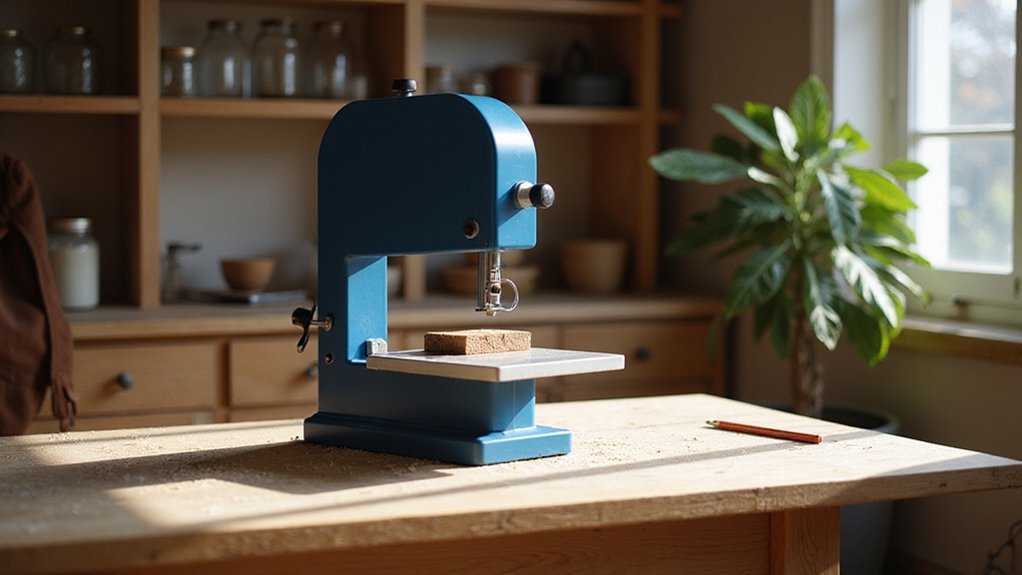
Before you pick a small band saw for your craft projects, you’ll want to focus on five key factors: blade material types, motor power output, cutting depth capacity, table size and tilt, and dust collection ports. Each of these elements directly impacts your precision, ease of use, and safety, so don’t overlook them. And remember, a well matched combination of these features makes all the difference for smooth, accurate cuts.
Blade Material Types
Consider three main blade material types when you’re picking a small band saw for your craft projects.
First, steel blades. Usually high speed or alloy steel, they’re your go to for woodworking. Strong yet flexible, they handle curves well and offer reliable cuts for softer materials.
Second, carbide tipped blades. Those tiny carbide teeth deliver serious longevity and cutting accuracy. They excel on abrasive or hard materials, saving you from frequent blade swaps.
Third, diamond blades. These highly abrasive blades are ideal for tough or delicate materials like glass, rocks, or coral. They cut cleanly where steel or carbide would struggle.
Your choice directly affects precision, durability, and the quality of finished crafts. Match the material to your project, and you’ll get smoother cuts and less frustration.
Motor Power Output
Since motor power output directly determines what your small band saw can actually cut, you’ll want to pay close attention here. Lower horsepower motors (like 1/6 HP) will struggle with anything tougher than balsa wood. For a versatile craft saw that handles wood, plastic, and soft metals, aim for at least 1/4 HP. Want even smoother cuts and less strain on long projects? Step up to 1/3 HP or 350 watts. You’ll notice the difference immediately: cleaner cuts, fewer stalls, and a machine that doesn’t whine under pressure. And remember, wattage and amperage ratings matter too. They directly influence your saw’s cutting speed and overall performance. Don’t skimp here. A motor that’s too weak will frustrate you, while one that’s adequately powered makes every project feel effortless.
Cutting Depth Capacity
You’ve heard about motor power, but now let’s talk about what that blade can actually reach. Cutting depth capacity is the maximum height of material you can slice through, typically 3 to 4 inches on small models. That’s a big deal. A larger capacity means you can handle thicker stock, opening up more complex projects. But here’s the trade off: smaller capacities often make the saw more compact and portable. So, know your max cut height before you buy. It prevents overloading the saw, which leads to inaccurate cuts or damage. For most crafts, 3 inches works for thin woods and plastics. Go for 4 inches if you’re tackling thicker boards or stacked materials. Measure your typical project thickness first. That simple step saves you from frustration and keeps your cuts precise.
Table Size & Tilt
Cutting depth is only half the story, because even a powerful saw is frustrating if your workpiece doesn’t sit steady. That’s where your saw’s table comes in. Its size determines the maximum material width you can support comfortably. Go for a larger table, or at least one that’s adjustable, to handle bigger, more complex pieces without wobbling.
But here’s where the real crafty magic happens: tilt capability. You need that table to angle up to 45° or more for bevels and miter joints. Without it, you’re stuck making only straight cuts. A stable, well built table with clear markings means you can tilt precisely, cut confidently, and nail those intricate angles. Don’t settle for a tiny, fixed table. A versatile one lets your projects grow, not your frustration.
Dust Collection Ports
While the blade and table grab the spotlight, the humble dust port quietly determines whether your workspace feels like a serene craft studio or a chaotic woodshop after a storm. You’ll want a port at least 2½ inches wide for strong suction, plus a second port near the lower wheel to catch falling debris. Check its location: a rear port keeps your hose out of the way, while a side port might tangle with your material. Connect it to your shop vac or dust collector for serious filtration, and grab a compatible adapter if needed. That cleaner air means fewer sneezes and less cleanup, letting you focus on the cut, not the mess. It’s a small detail that makes a big difference.
Noise & Vibration Levels
Ever sneezed from sawdust and wished your workshop felt more like a library than a construction site? Noise levels below 70 decibels are your sweet spot, sparing your ears and stamina during long craft sessions. Vibration, though, is the sneaky culprit. Keep it under 6 mm/s; anything higher rattles your hands and blurs those exact cuts.
You’ll want damping features, like dynamically balanced blade assemblies and vibration-absorbing materials, to kill mechanical oscillations before they start. Here’s the kicker: excessive shaking wears blades faster and tanks accuracy, so control isn’t luxury, it’s longevity.
And remember, these two are joined at the hip. Cut vibration, and you’ll automatically quiet things down, perfect for shared spaces or noise-sensitive neighbors. Prioritize both, and you’ll craft in calm, precise comfort.
Portability & Weight
Noise and vibration might rule your comfort and accuracy, but once your band saw’s smooth and quiet, the next question is: can you take it where you need it? Portability hinges on weight. You’ll want a model under 15 pounds for easy lifting between benches, especially if you’re hauling it to craft fairs or shared studios. Quick setup and breakdown save you real time, so a lighter unit wins there.
- For workshop hopping, under 15 pounds means you can carry it one-handed.
- Over 20 pounds, you’re wrestling with carts or asking for help, which kills spontaneity.
Think about your routine: if you move often, that extra poundage adds up fast. Choose light, and you’ll actually use it wherever inspiration strikes, not just where you bolted it down.
Safety Features Included
Because even a precise cut means nothing if your hand’s in the blade’s path, safety features should top your checklist. You’ll want dual power buttons, which stop accidental startups. And don’t overlook adjustable or transparent blade guards, they let you see the cut while keeping your fingers clear. Look for safety interlocks too, these prevent the saw from restarting after you’ve made adjustments or changed blades.
Dust collection ports aren’t just for cleanup. They pull debris away, so you can see your line and avoid slips. Finally, check for an emergency stop button, reachable in a flash. That quick shutoff is your last line of defense.