You know that feeling when you’re hand-feeding a heavy board and your arm starts to shake. That’s exactly what a power feeder eliminates. These five models combine strong motors, adjustable speeds, and stable builds to turn grueling rip cuts into smooth, consistent passes. Let’s see which one fits your shop best.
| Infinity Tools Mini Power Feeder (MPF-001) Variable Speed | 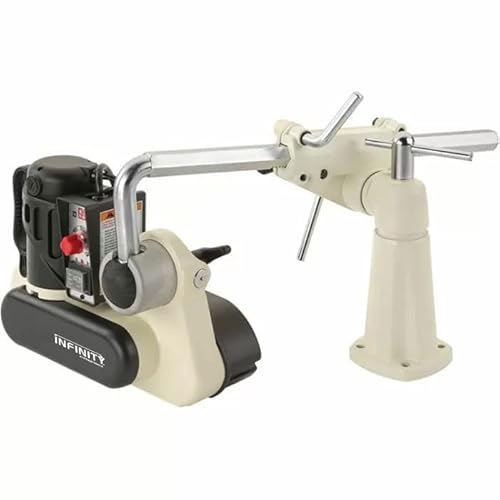 | Best Compact Pick | Horsepower: 1/8 HP | Weight: 26 pounds | Number of Rollers: 1 roller (spring-loaded polyurethane) | VIEW LATEST PRICE | Read Our Analysis |
| Powermatic 4-Roll Power Feeder 1 HP 115V 1Ph (Model PF-41) |  | Best Heavy-Duty | Horsepower: 1 HP | Weight: 150 pounds | Number of Rollers: 4 rollers | VIEW LATEST PRICE | Read Our Analysis |
| Powermatic 3-Roll Power Feeder 1 HP 115V 1Ph (Model PF-31) |  | Runner-Up Heavy-Duty | Horsepower: 1 HP | Weight: 134 pounds | Number of Rollers: 3 rollers | VIEW LATEST PRICE | Read Our Analysis |
| Powermatic 3-Roll Power Feeder 1/4 HP 115V 1Ph (Model PF3-JR) |  | Best Mid-Range | Horsepower: 1/4 HP | Weight: 71 pounds | Number of Rollers: 3 rollers | VIEW LATEST PRICE | Read Our Analysis |
| Grizzly Industrial G4173-1/8 HP Power Feeder |  | Best Budget-Friendly | Horsepower: 1/8 HP | Weight: 27 pounds | Number of Rollers: 3 rollers (synthetic rubber) | VIEW LATEST PRICE | Read Our Analysis |
More Details on Our Top Picks
Infinity Tools Mini Power Feeder (MPF-001) Variable Speed
If you’re working with a compact shop or need to move your feeder between machines, the Infinity Tools Mini Power Feeder (MPF-001) is a standout choice for a space saving yet capable option. Its 1/8 HP motor gives you variable speeds from 6.5 to 56 FPM, and the reversible feed lets you switch between climb or conventional cuts. You can mount it horizontally on your table or vertically on the fence. Spring loaded polyurethane rollers grip your workpiece without marring, so you get consistent, burn free cuts. All in a durable cast iron housing that weighs just 26 pounds.
- Horsepower:1/8 HP
- Weight:26 pounds
- Number of Rollers:1 roller (spring-loaded polyurethane)
- Feed Speed Range:6.5 to 56 FPM (variable speed)
- Adjustability (Mounting Positions):Horizontal on tables or vertical on fences
- Construction Material:Cast iron housing with metal drivetrain
- Additional Feature:Reversible feed direction
- Additional Feature:Spring-loaded polyurethane rollers
- Additional Feature:Cast iron housing
Powermatic 4-Roll Power Feeder 1 HP 115V 1Ph (Model PF-41)
The Powermatic PF-41’s cast iron build gives it a heft that simply outclasses the rest. You’ll feel that stability immediately; no vibration here. Its continuous-duty motor transfers power through a roller chain and sprockets to four easily replaceable tires.
You get full adjustability too. The support column locks horizontally, vertically, or at any angle. Universal joints keep everything stable.
Here’s what’s included:
- Feeder, mounting assembly, and boring template
- Grease gun (just add grease)
- Handle over arm with hardware
At 1 HP and 115V, it’s a workhorse. Weighing 150 pounds, it’s not portable, but that’s the point. It stays put, feeds consistently, and minimizes downtime. A 5-year warranty backs it up.
- Horsepower:1 HP
- Weight:150 pounds
- Number of Rollers:4 rollers
- Feed Speed Range:Not specified
- Adjustability (Mounting Positions):Horizontal, vertical, or angled
- Construction Material:Solid cast iron body, base, and universal joints
- Additional Feature:Quick-change roller tires
- Additional Feature:Grease gun included
- Additional Feature:Lockable universal joints
Powermatic 3-Roll Power Feeder 1 HP 115V 1Ph (Model PF-31)
Powermatic’s PF-31 is the runner-up heavy-duty pick for pros who need continuous, vibration-free feeding. You get a solid cast iron body, base, and universal joints that kill vibration dead, even at full tilt. The 1 HP motor pushes material at a steady 108 feet per minute, and the roller chain and sprockets keep your feed positive and consistent. Maintenance is simpler too: the smart roller system lets you swap tires without replacing the whole assembly. Plus, you can mount it horizontally, vertically, or at an angle. It weighs 134 pounds, so you won’t move it on a whim. And there’s a 5 year warranty backing it up.
- Horsepower:1 HP
- Weight:134 pounds
- Number of Rollers:3 rollers
- Feed Speed Range:Approximately 108 FPM (fixed)
- Adjustability (Mounting Positions):Horizontal, vertical, or angled
- Construction Material:Solid cast iron body, base, and universal joints
- Additional Feature:Smart roller system
- Additional Feature:Alloy steel components
- Additional Feature:Lockable support columns
Powermatic 3-Roll Power Feeder 1/4 HP 115V 1Ph (Model PF3-JR)
You’ll get a solid mid-range performer with the Powermatic PF3-JR. Its 1/4 HP motor easily handles most materials, thanks to a rugged roller chain and sprocket design that delivers positive, vibration-free feeding. The cast iron body and base keep everything stable, while fully adjustable support columns and universal joints let you feed horizontally, vertically, or at an angle. Roller tires swap out quickly without replacing the whole assembly. And with a 5-year warranty (2-year for commercial use), you’ve got long-term peace of mind. It’s a dependable workhorse for serious projects.
- Horsepower:1/4 HP
- Weight:71 pounds
- Number of Rollers:3 rollers
- Feed Speed Range:Not specified
- Adjustability (Mounting Positions):Horizontal, vertical, or angled
- Construction Material:Solid cast iron body, base, and universal joints
- Additional Feature:Stand assembly included
- Additional Feature:Interchangeable rollers
- Additional Feature:2-year commercial warranty
Grizzly Industrial G4173-1/8 HP Power Feeder
If you’re feeding long or wide stock through your table saw on a regular basis, the Grizzly Industrial G4173 gives you budget friendly power and adjustability without skimping on safety. Its 1/8 HP motor offers multiple feed speeds from 6 1/2 to 39 FPM. You can dial in forward or reverse rotation, and the X, Y, and Z adjustments help you position those three synthetic rubber rollers precisely. They’re 1 3/16 inches wide and reach up to 6 inches high. Plus, vertical and horizontal movement spans about 10 1/4 inches each, so you’ll handle varied stock easily. It’s CSA certified, too.
- Horsepower:1/8 HP
- Weight:27 pounds
- Number of Rollers:3 rollers (synthetic rubber)
- Feed Speed Range:6.5 to 39 FPM (variable speed)
- Adjustability (Mounting Positions):X, Y, and Z adjustments; forward and reverse rotation
- Construction Material:Not specified
- Additional Feature:CSA certified safety
- Additional Feature:Forward/reverse rotation
- Additional Feature:Easy-refill top design
Factors to Consider When Choosing Table Saw Power Feeder
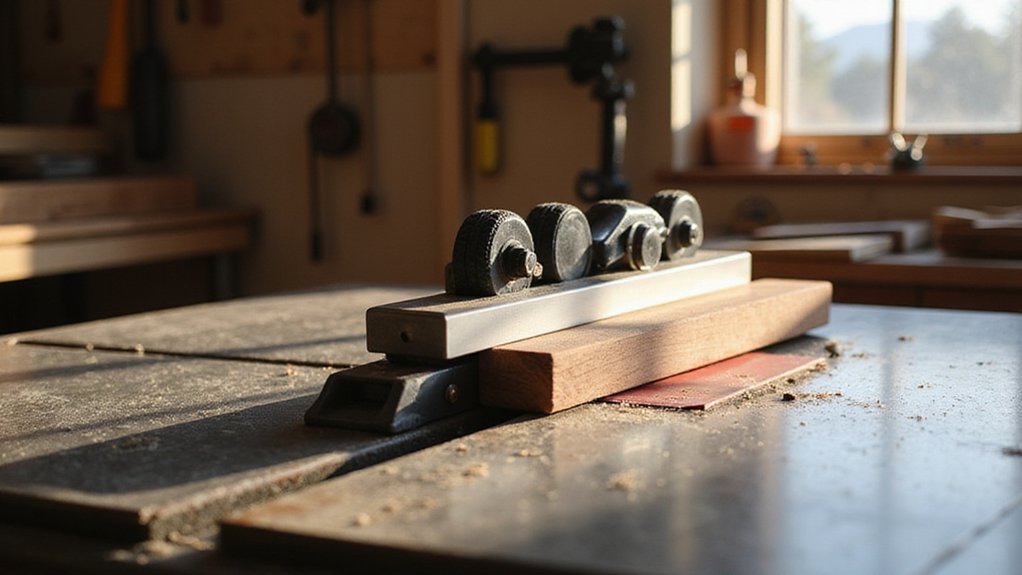
You’ll want to zero in on horsepower and motor power first, since that directly determines how well your feeder handles dense hardwoods without stalling. Next, look at the feed speed range and roller quantity or type, because a wider speed range and more aggressive rollers give you finer control over different materials. And don’t overlook mounting flexibility, build material, and weight, as these factors decide how easily you can attach the feeder and how stable it stays during heavy cuts.
Horsepower & Motor Power
Since horsepower directly determines how well your power feeder handles heavy workloads, you need to match motor strength to the material you feed most. For demanding tasks like ripping thick hardwoods or dense plywood, a 1 HP motor gives you the torque to power through without stalling. That’s a big step up from smaller 1/4 HP or 1/8 HP units, which work fine for light stock but choke under pressure. Don’t overlook the motor’s continuous-duty rating either. It tells you the feeder can run steadily for hours on end without overheating, which is vital for production runs. More powerful motors also keep the feed smooth and stable, reducing slips during those aggressive cuts. So, if you’re frequently feeding larger stock, invest in higher horsepower. It’ll save you frustration and keep your workflow consistent.
Feed Speed Range
What does the feed speed range actually do for your cuts? It dictates how quickly the stock travels past the blade, which directly impacts both finish quality and your safety. A wider range gives you serious versatility; you’ll dial in a slower, deliberate pace for fragile veneers or tricky hardwoods, then crank it up for ripping through soft pine. Faster speeds boost your throughput, sure, but they can sacrifice precision if you’re not careful. Match the speed to the project, not the other way around. Look for variable speed controls so you can fine-tune on the fly. An appropriate range also prevents burning or chipping by keeping the feed rate consistent with the material’s density. Ultimately, the right speed makes every pass smooth, clean, and predictable.
Roller Quantity & Type
When you’re looking at power feeders, the roller quantity and type are where the rubber really meets the road—literally. More rollers mean steadier hands. You’ll want at least four; they layer consistent pressure across the board, preventing drift and keeping thin stock flat without deflection. Fewer than three? You’re risking chatter.
Roller material matters too. Polyurethane grips aggressively without marring veneers, while rubber offers a softer touch for delicate surfaces. Look for replaceable tires, so you can swap compounds for different jobs instead of buying a new unit.
And check spacing. Evenly placed rollers distribute force cleanly, avoiding that annoying “walk” where the workpiece veers off-line. Short bursts versus longer runs: tight spacing handles small parts better, wider spacing excels on long boards. Choose what matches your daily workload.
Mounting Flexibility Options
Mounting flexibility is where a power feeder really earns its keep, because you need that unit to adapt to your workflow, not the other way around. Look for a model you can mount both horizontally on your table and vertically on your fence, covering any task. Pick one with adjustable support columns and moveable universal joints, letting you dial into precise angles and heights without wrestling the machine.
You’ll also want easy switching between configurations. No one wants to dig out tools for a simple reposition. Prefer units with lockable universal joints and adjustable height supports. These lock solidly, keeping everything stable and safe regardless of where you mount it.
Finally, check that it comes with compatible clamps or brackets for your specific saw setup. A feeder that doesn’t fit securely is a waste of bench space. Choose one that clicks into place, and your workflow will thank you.
Build Material & Weight
Build material and weight aren’t just specs on a page; they’re the backbone of your power feeder’s reliability and performance. Cast iron or steel models bring serious durability and vibration dampening, so you get smoother, more precise feeding. But let’s be honest: heavier units are a pain to move or adjust. Lighter aluminum feeders are easier to handle, though you might sacrifice some stability and long term toughness.
Your goal? Find a balanced weight to build material ratio. You want enough heft to keep vibration low and cuts steady, but not so much that repositioning feels like a workout. For most shops, a sturdy steel feeder with moderate weight hits that sweet spot between rock solid stability and manageable portability. Don’t overthink it, just match the feeder’s heft to your typical workflow.
Warranty Coverage Length
Warranty coverage length for table saw power feeders typically ranges from 1 to 5 years, and that span can tell you a lot about what you’re buying. A 5-year limited warranty screams confidence, plain and simple. You’ll spot it on heavy-duty models built for daily abuse. On the flip side, lighter or specialized feeders often come with just 1 or 2 years, which hints they’re not meant for marathon sessions.
Don’t overlook this number when weighing value. A shorter warranty might mean higher out-of-pocket repair costs down the road. But here’s a trick: some makers sell extended coverage for a fee, stretching protection beyond the standard term. That’s worth it if you’re pushing your feeder hard. Always check what’s covered, not just the years. Motors? Gears? Even the switch? Know before you buy.